Toad Craft 09
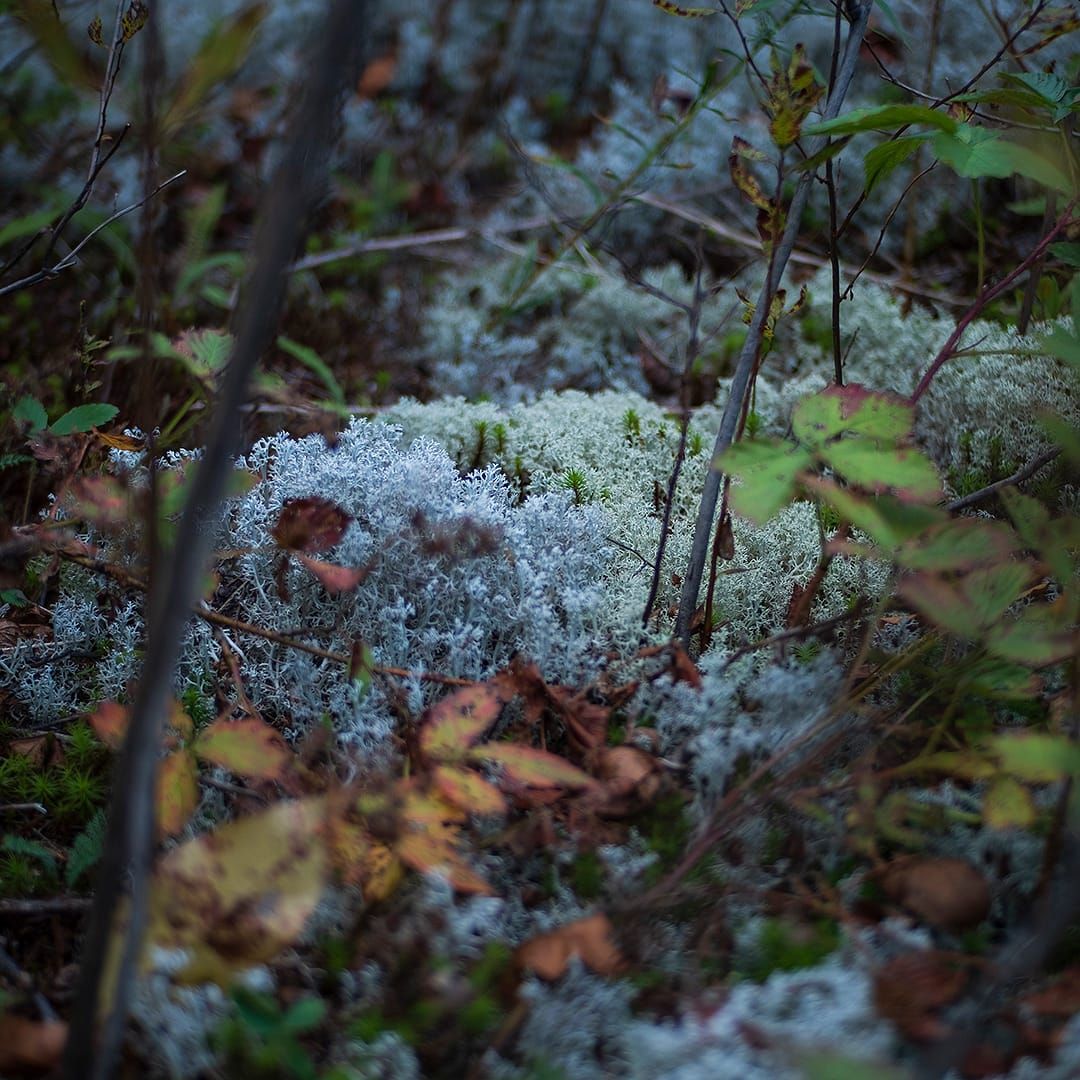
In the last issue I mentioned how I'd be getting into washi next, but turns out nature had other plans for me this past week. When the lichens call, I pick up.
I must admit that I am prone to wandering off. On our daily dog walks, Steff is often left holding the leash after I've taken a sudden turn off trail into some dark thicket. Usually, as my eyes adjust to the dim light of the undergrowth, that rare mushroom or critter I was chasing turns into a leaf. Still, once inside that unfamiliar space just off trail, I feel an undertow pulling me ever deeper. I know I only have a few more minutes before Steff me calls back, or else risk being left behind. Needless to say I am always catching up.
I'm reminded of a clever tactic my parents used to deploy on me when I was little. They'd only take me to Toys R' Us about 30 minutes before closing time, that way I'd always be forced out by the anxiety of being locked inside overnight. Perhaps Steff should only take me into the forest 30 minutes before dark.
In any case, It's become obvious to me that my "happy place" is in the searching. Whether it be for fungi, orchids, bones, or salamanders, I tend to preface every nature walk with a secret mission in my mind. And when that search heats up, the world outside of the forest melts away as I get lost in the pursuit of whatever trinket I'm looking for that day.
Enter, lichens. They have many qualities that I admire in a thing; small, mysterious, utterly unique. And, while they're everywhere, I get the sense that they go mostly unnoticed, living quiet, slow, lives. They're permanent residents on my watch list.
After finding said lichens, there is the collecting of specimens, and ultimately the archiving or showcasing. It's lucky, then, that they keep quite well in captivity... capable of a sort of self preservation upon drying... not a common attribute among other colourful organic things of this world.
When properly preserved, lichens continue to exhibit their natural colour and shape for years. For the Toads on/off button they were an obvious choice. The acrylic lenses press fit into each button shell help to magnify the lichens miniature details... allowing for these quiet creatures to shine.
Around here, lichens grow everywhere, but usable specimens are few. They are a bit like precious gems in that way... you may find an area where they are abundant, but stones that are gem quality, suitable for faceting, those will be rare.
For the most part, I only like to harvest lichens from fallen branches and downed trees, or areas where they are growing in such abundance that a few missing clumps would go unnoticed. My harvesting windows usually align with windy storms.
Every lichen has a very specific place that it has chosen to call home. In my experience, moving a lichen mere feet could kill it. So, any lichen that are found on downed branches will almost certainly die. This, in my mind, makes their harvesting feel more ethical.
Trees like maple, spruce, or poplar act as substrates for particular species of lichen. Lichens that colonize spruce, for example, will only be found in certain areas near the edge of a forest, on dead branches. They will never be found on any other tree except for spruce. Trees that are stunted, slow growing, continually pruned, etc.. often have more lichens.
Airflow, sunlight, and humidity also play a part. I've noticed many lichens will only grow at certain elevations on trees or rocks, usually found up high where it's drier, sunnier, and windier. Others prefer it down below in the dim stagnant dankness.
While I understand them to be natures extremophiles, I've only ever observed them to be quite fussy.
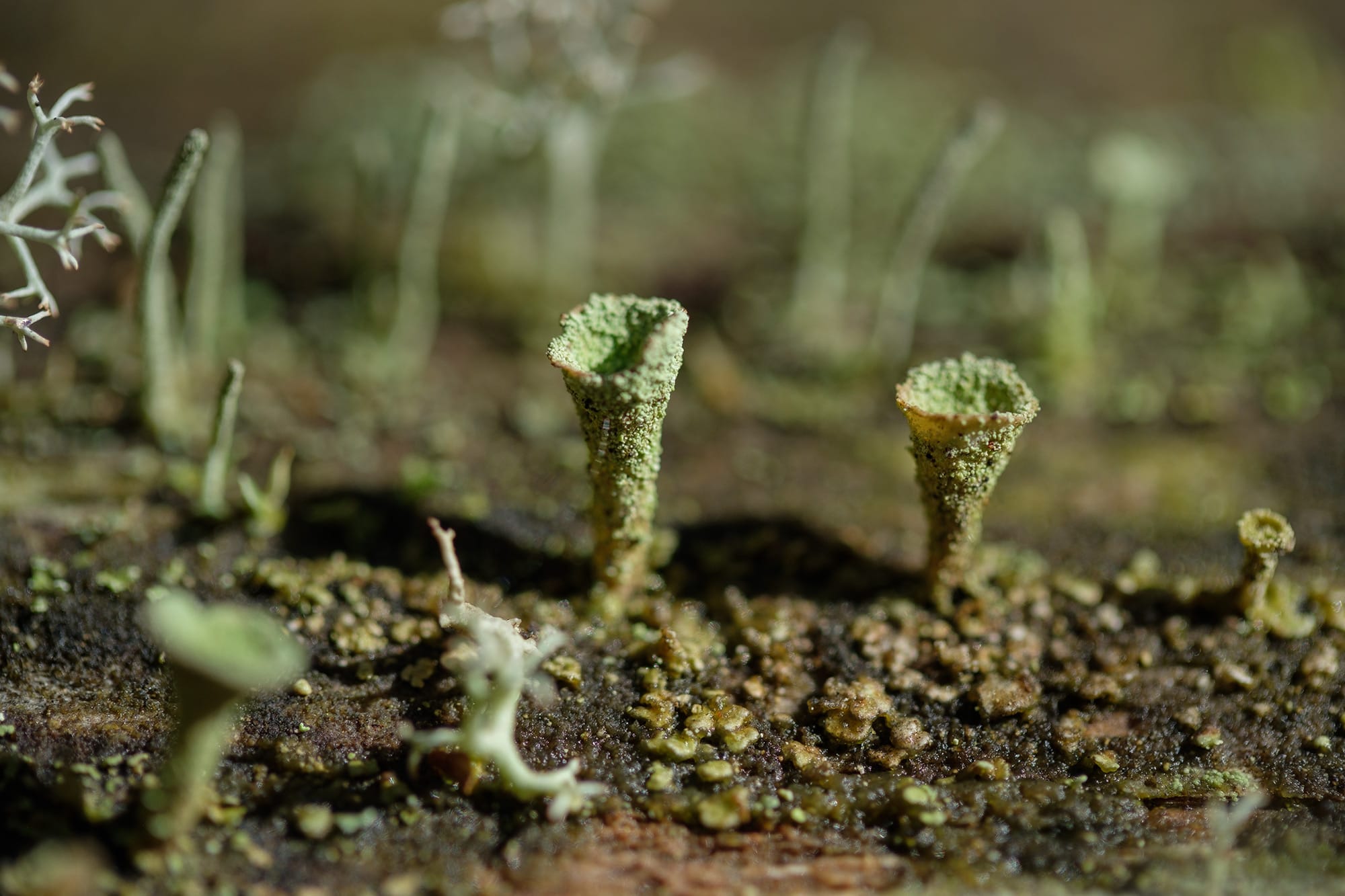
These goblet shaped lichens only sprout up on dead or dying woods.
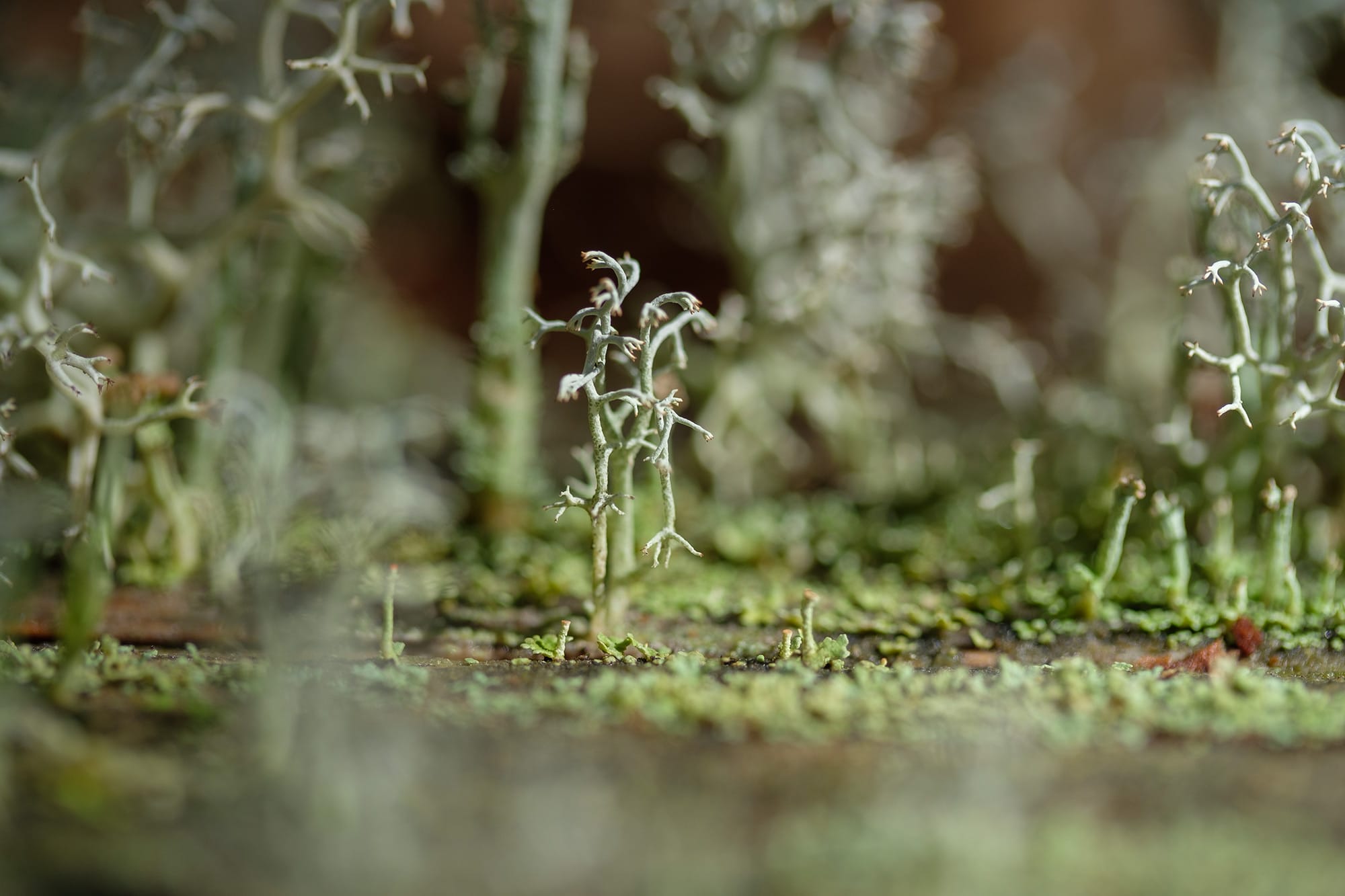
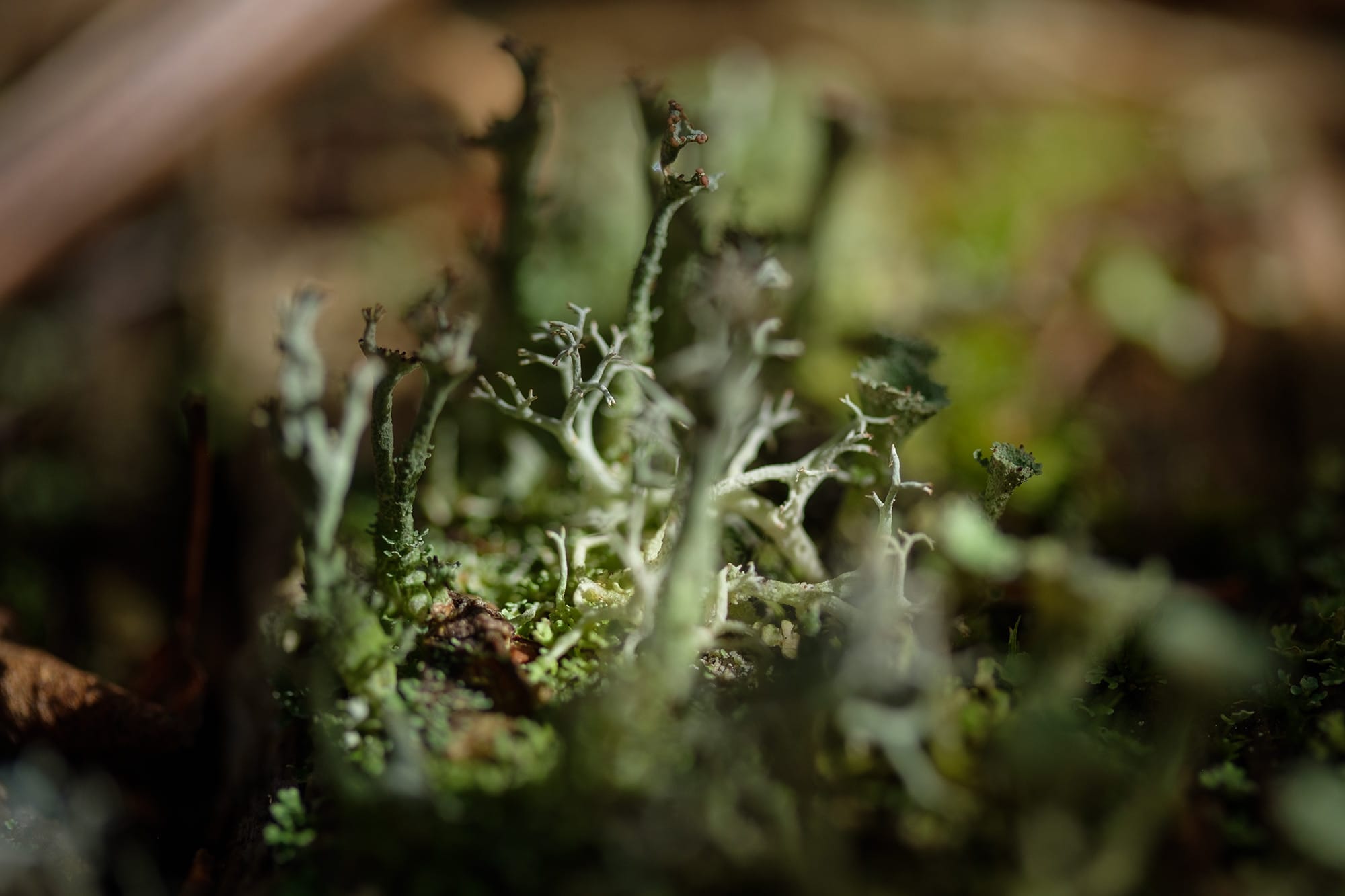
These fractal-like lichens would never be found growing on a living deciduous tree... preferring instead to nest in the conifers.
And while beautiful, these are not the type that I'm looking for.
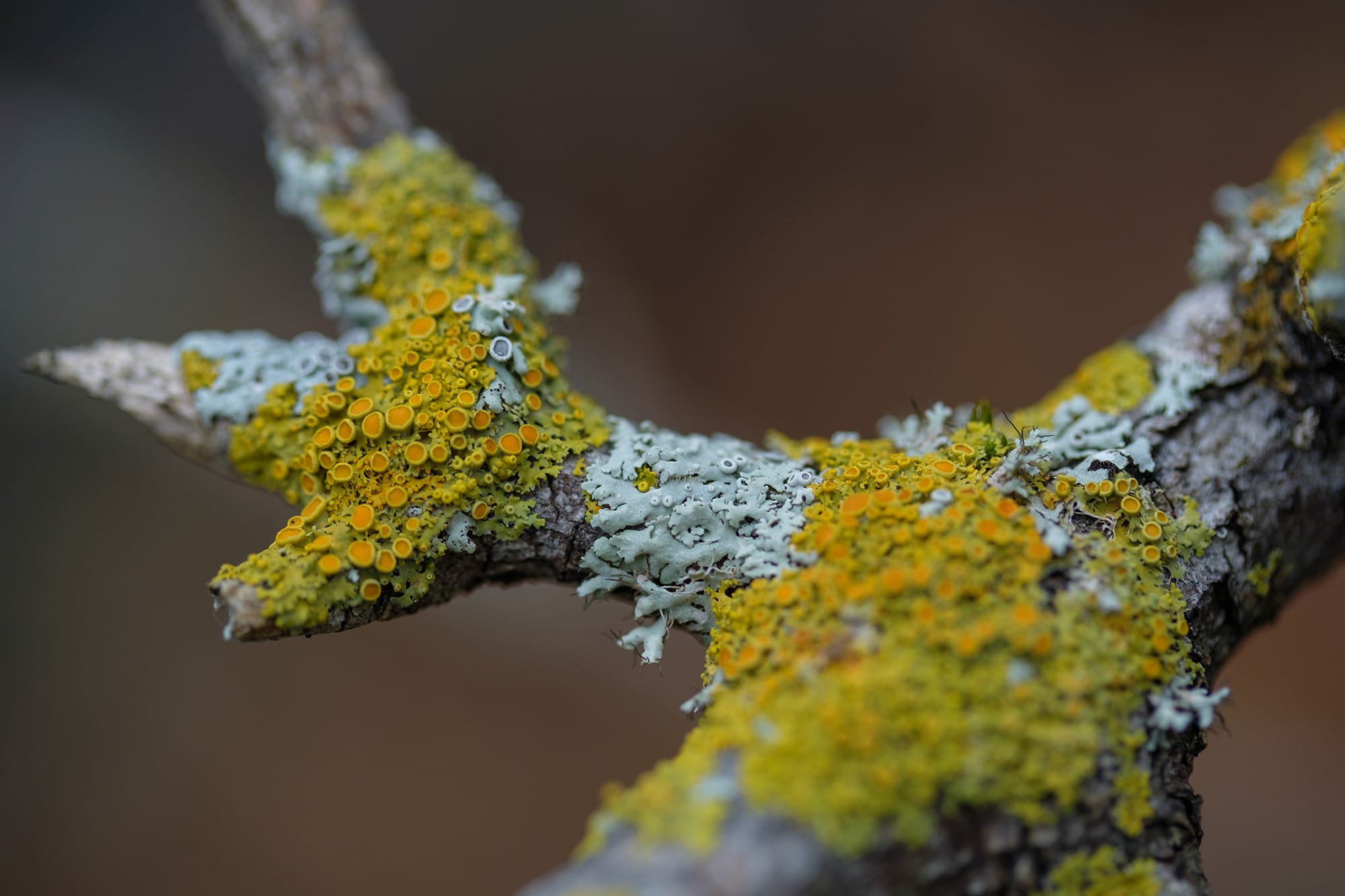
For my Toad buttons, I'm looking for dense, mature, lichens that have had time to form little saucer-shaped reproductive structures called apothecia. From these structures, the fungal component of a lichen produces spores.... and I just think they look really neat.
This past week, I stumbled upon a goldmine of these gem quality lichens along an urban path. Interestingly, I find that urban environments are some of the best lichen hunting grounds.
A few large trees had fallen, or were cut down by the city, and gave me a hoard of specimens to take home. Harvesting is done with a knife, saw, and some sort of container for storage.
Lichens are best harvested in damp weather. I want them dry enough to show their true colours, but wet enough to remain pliable. If the lichens are too dry they may crumble. Most often I'll take home the substrate (branch, bark, etc.) along with the lichen stuck to it for further processing.
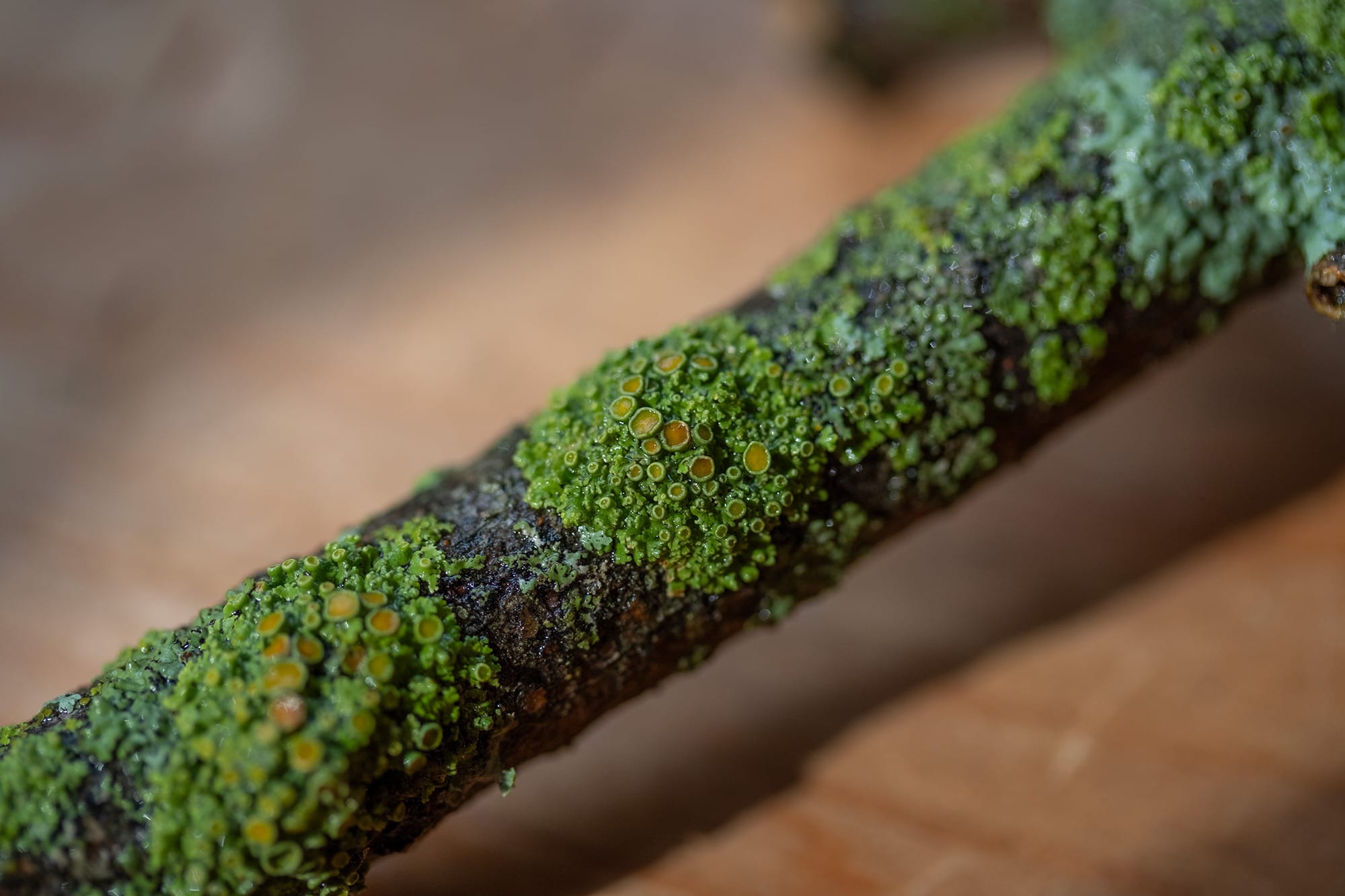
Once home, the fun begins. I start by wetting the lichens in water. These particular lichens turn vibrant green when wet but will dry much more yellow. When wet, their outer fungal layer becomes translucent, allowing their underlying algae (or cyanobactia) partner to shine through.
By wetting the lichens they become pliable.
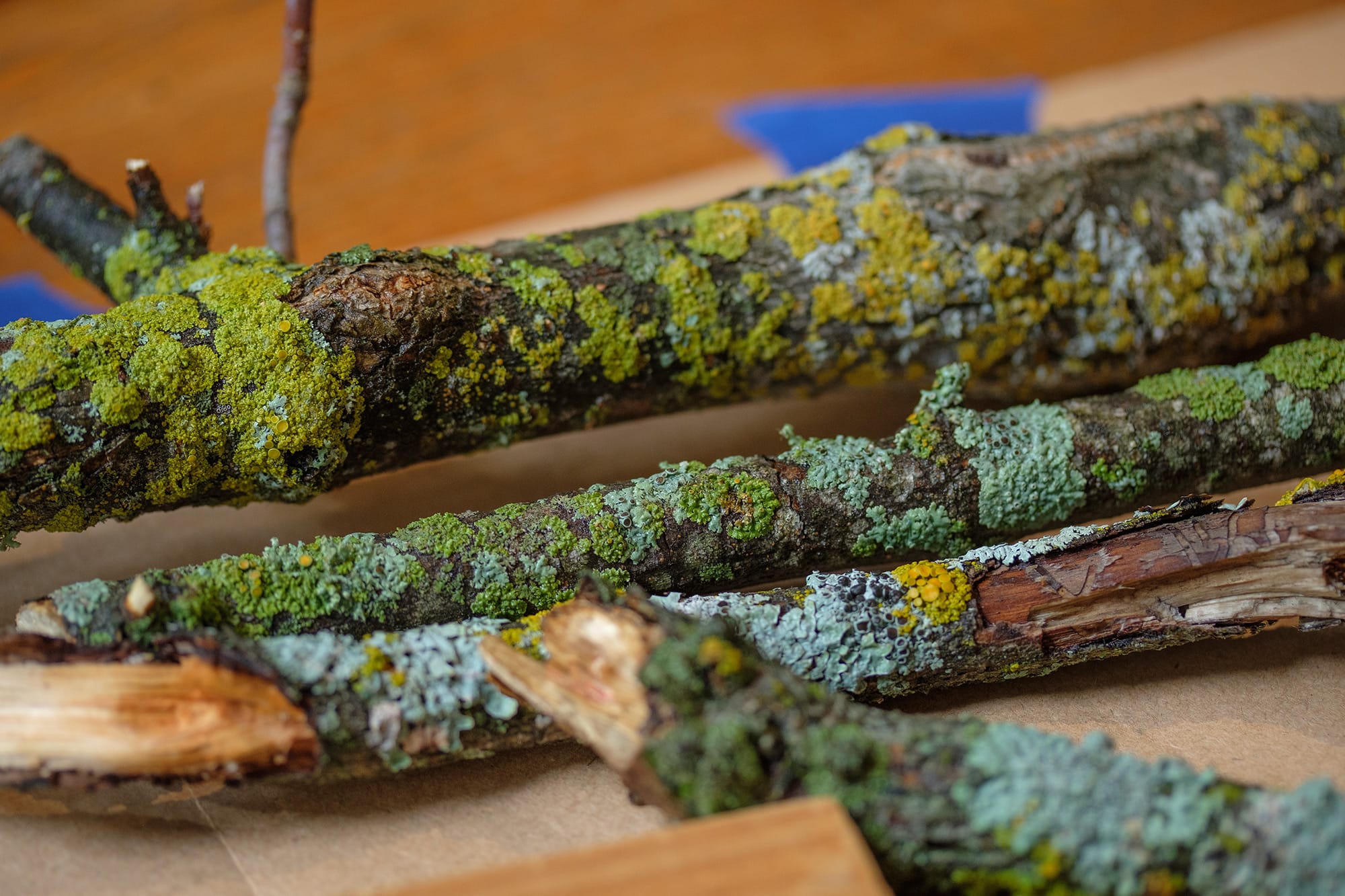
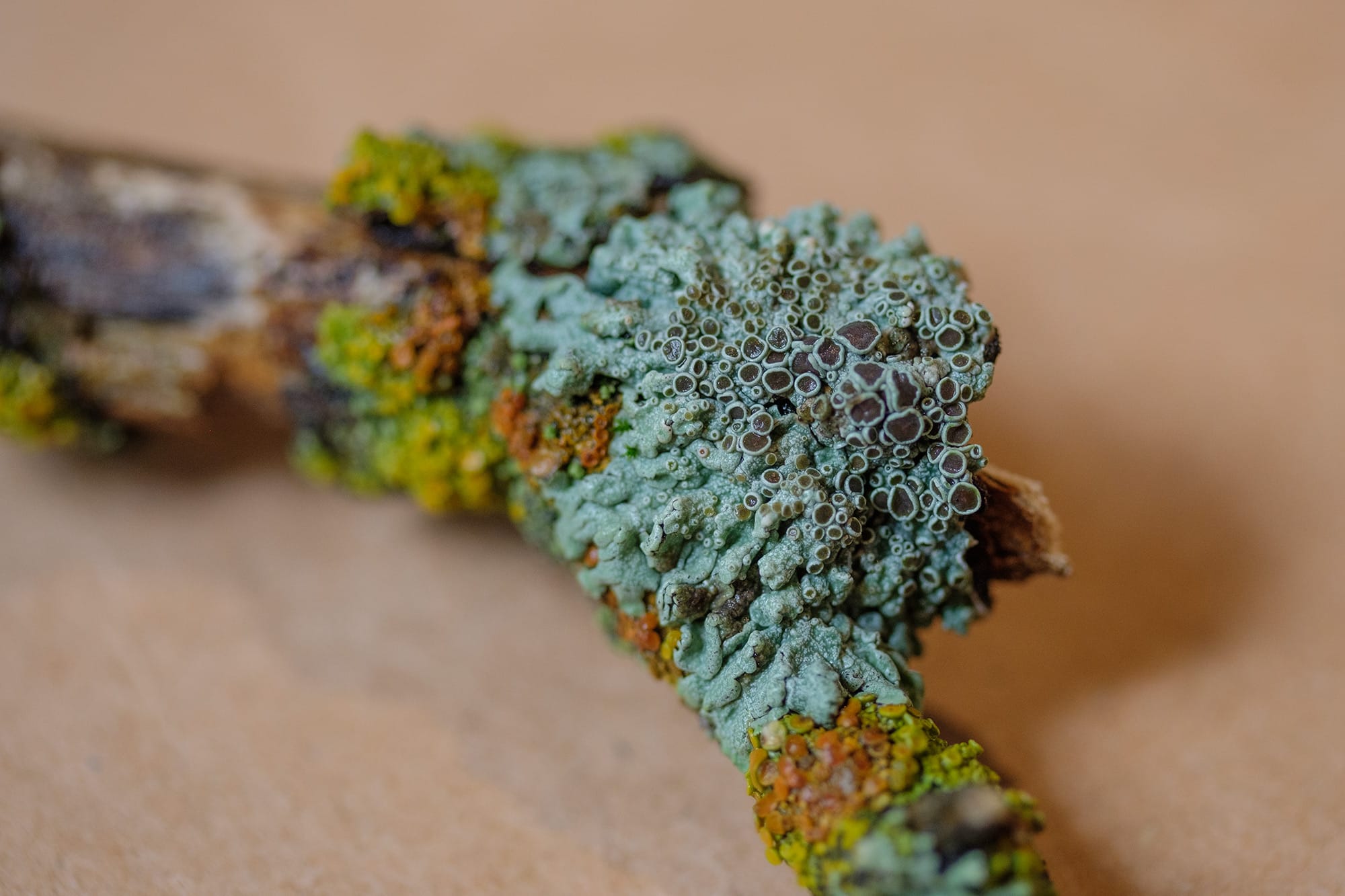
Most of these lichens are not usable, either due to being too thick, not big enough, weird lookin', or too delicate. Reject rate is high.
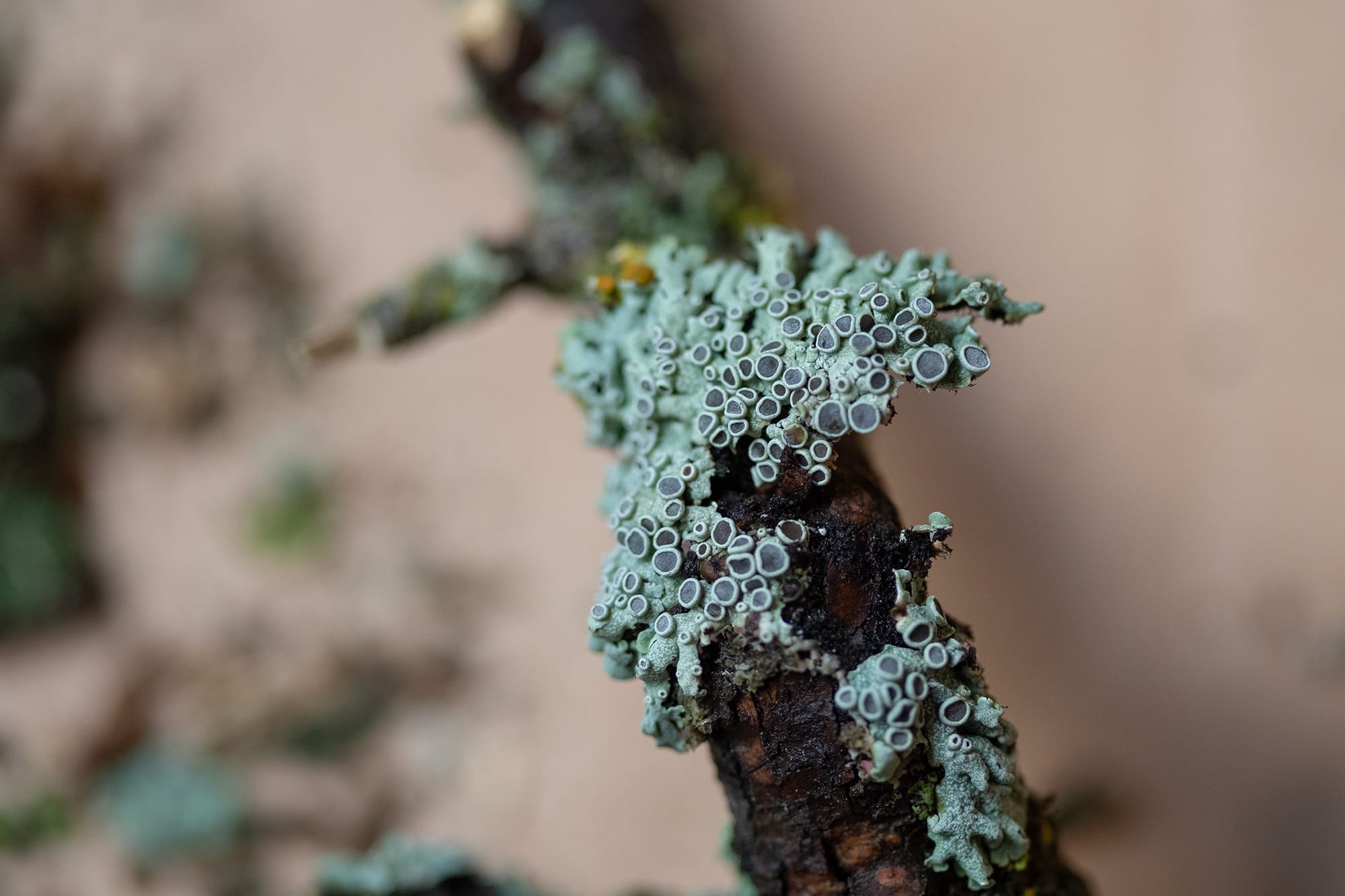
Some, like this one, will just fall apart before it can be removed from the substrate.
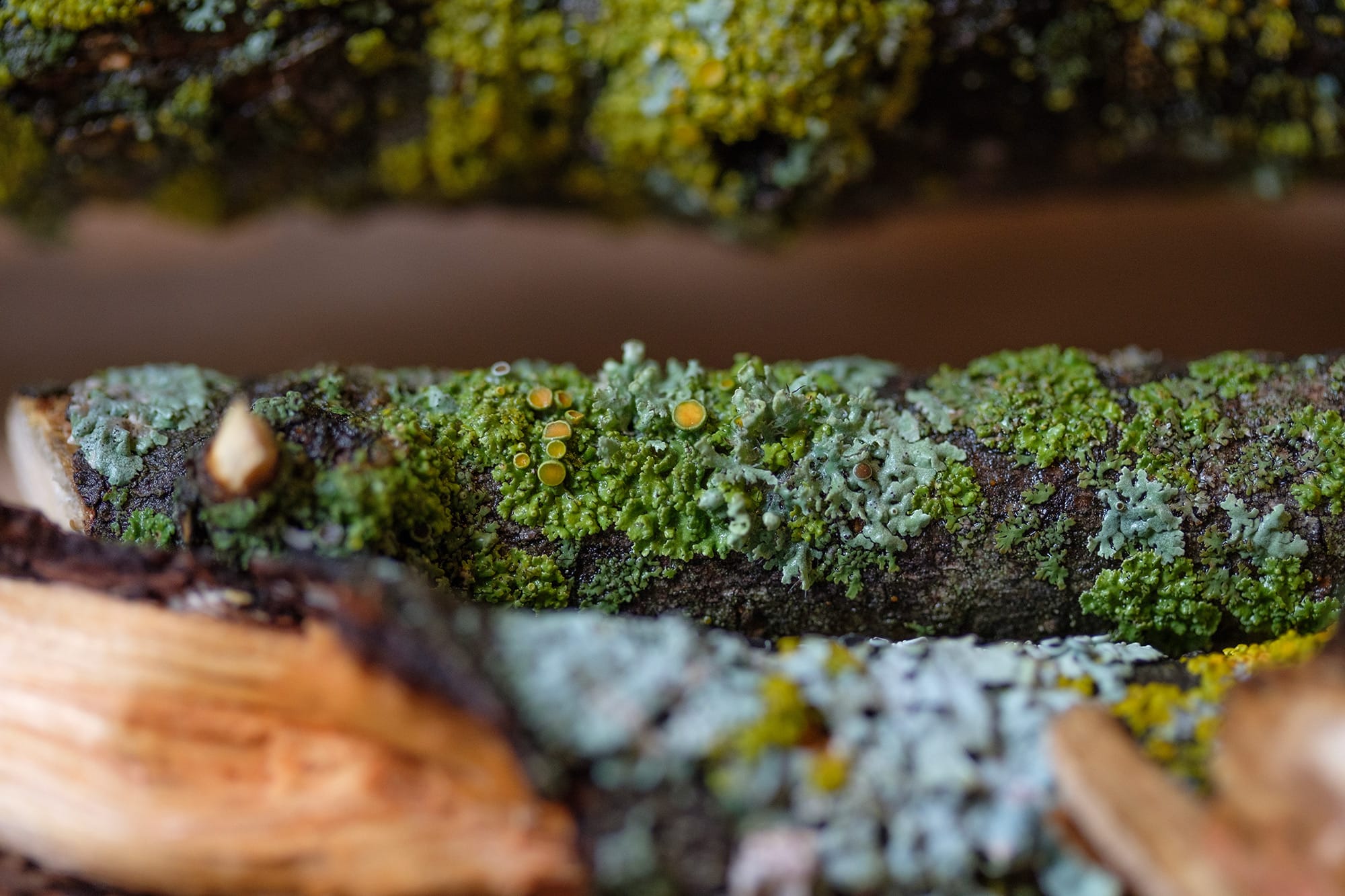
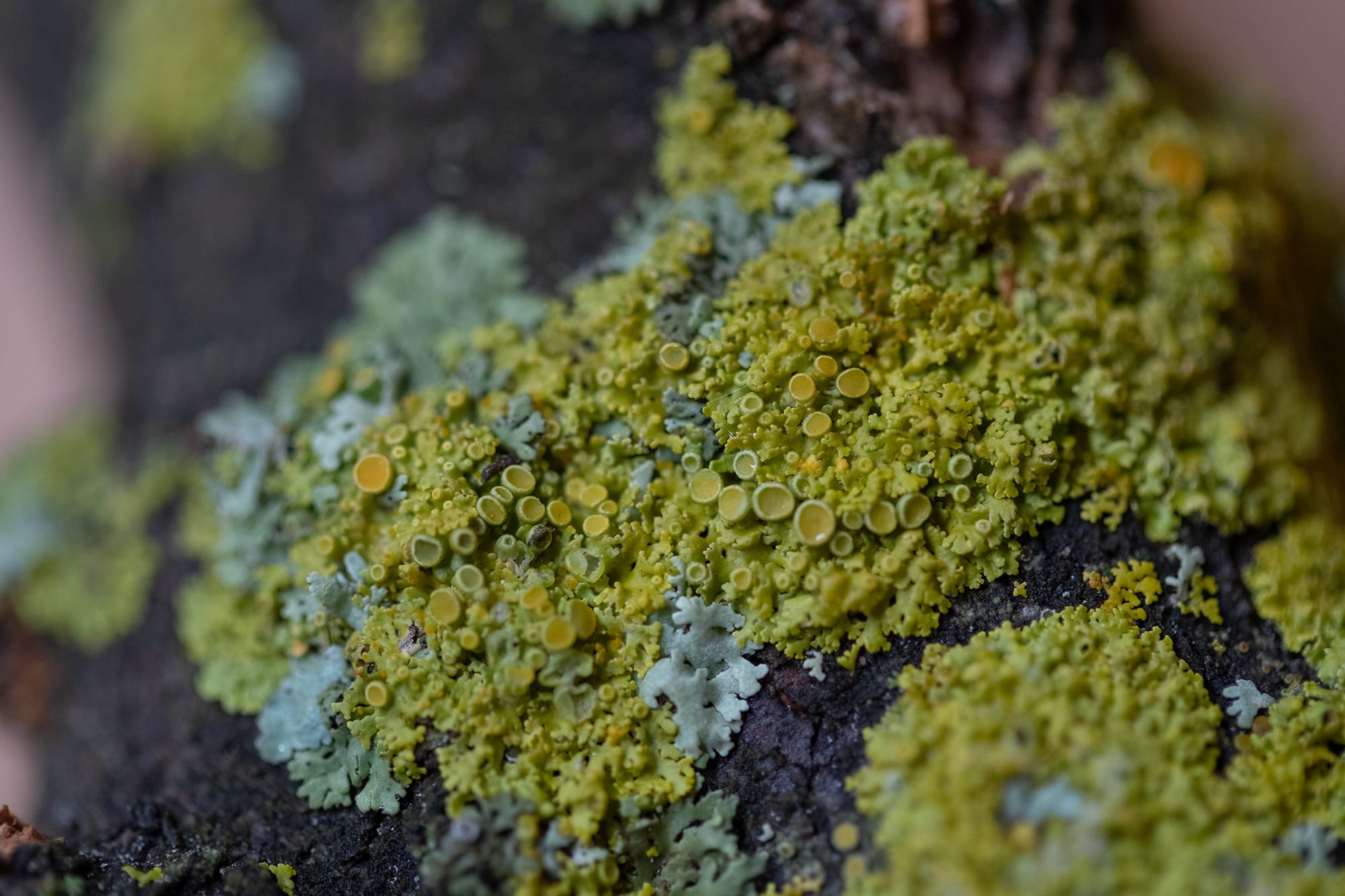
Some promising specimens.
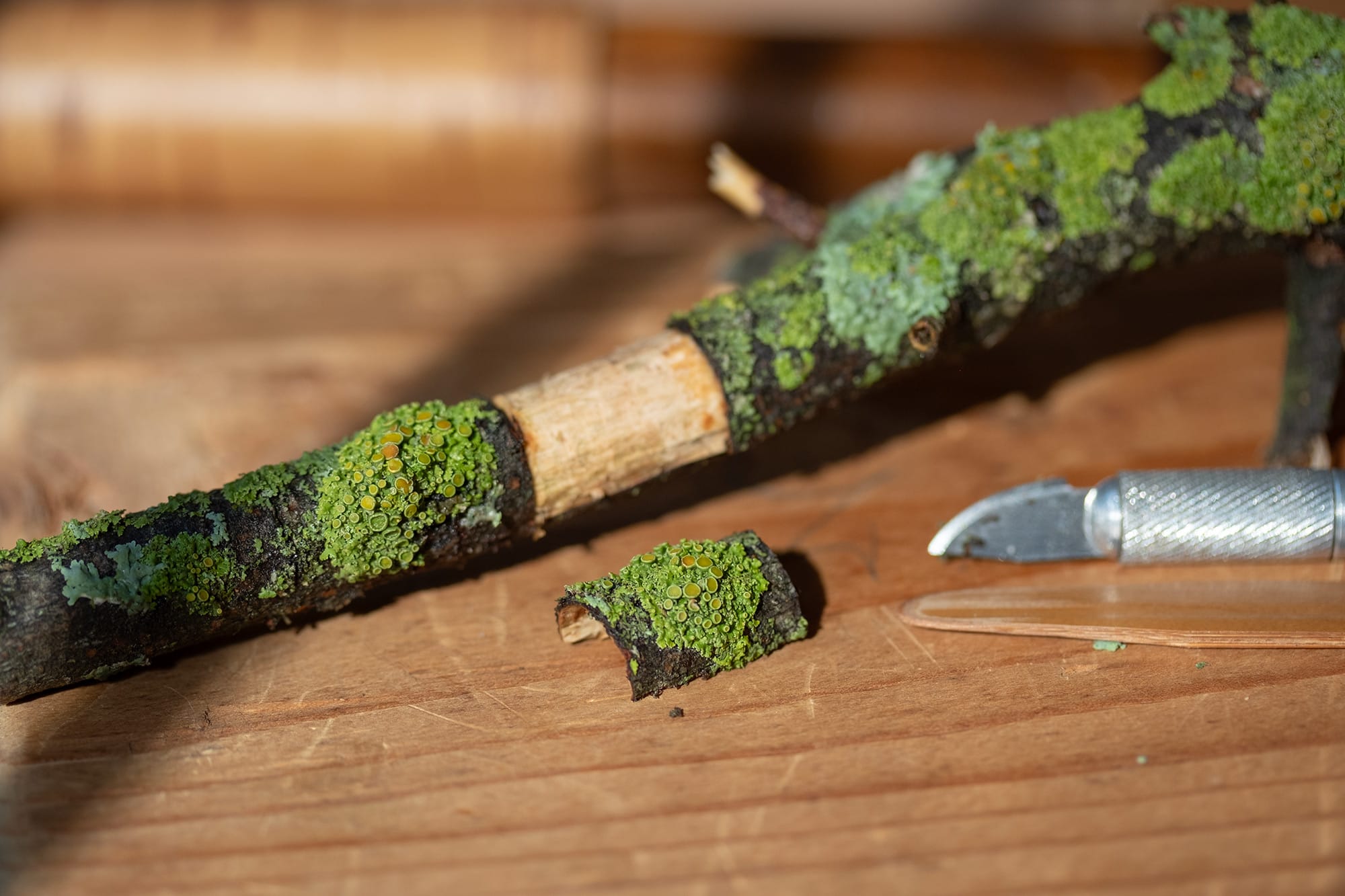
Maple bark is a joy. It's thin enough to be left as a backing for the lichen, making the preservation process a little easier. Thicker lichens or those growing on thick bark, need to be carefully cut from the substrate. They have a higher failure rate.
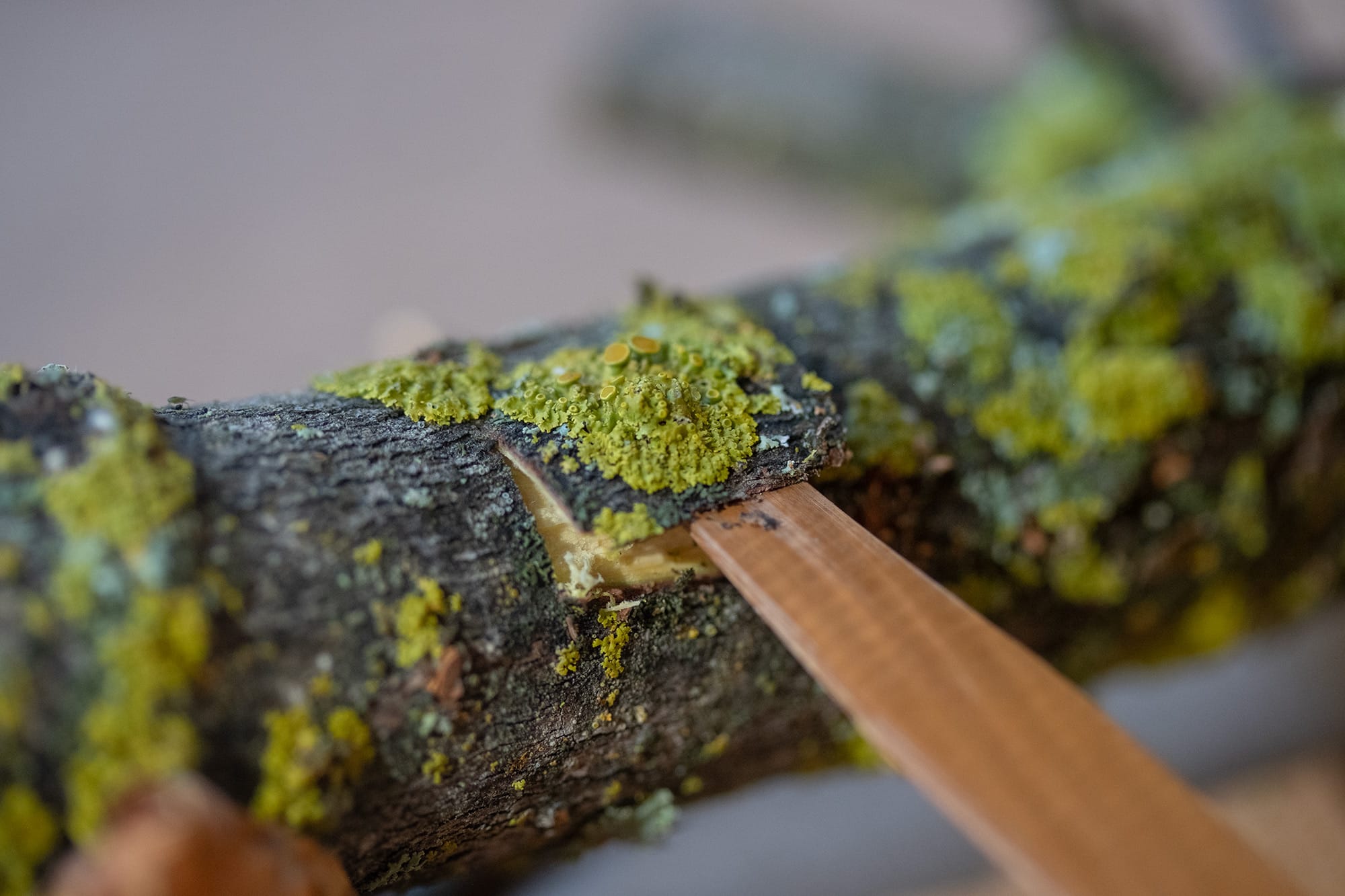
Various small knives and wooden pry sticks are used to tease each lichen from it's old home.
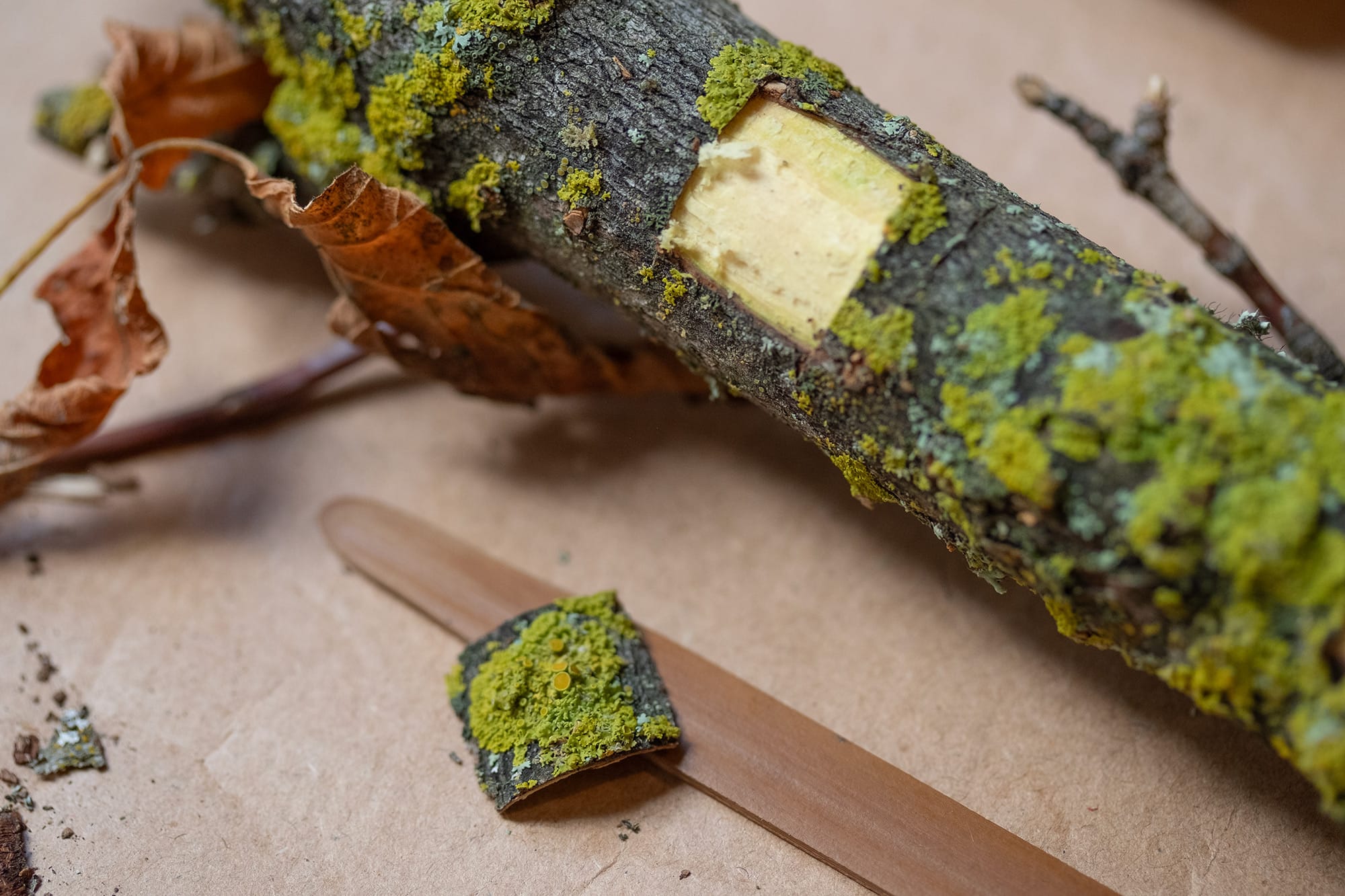
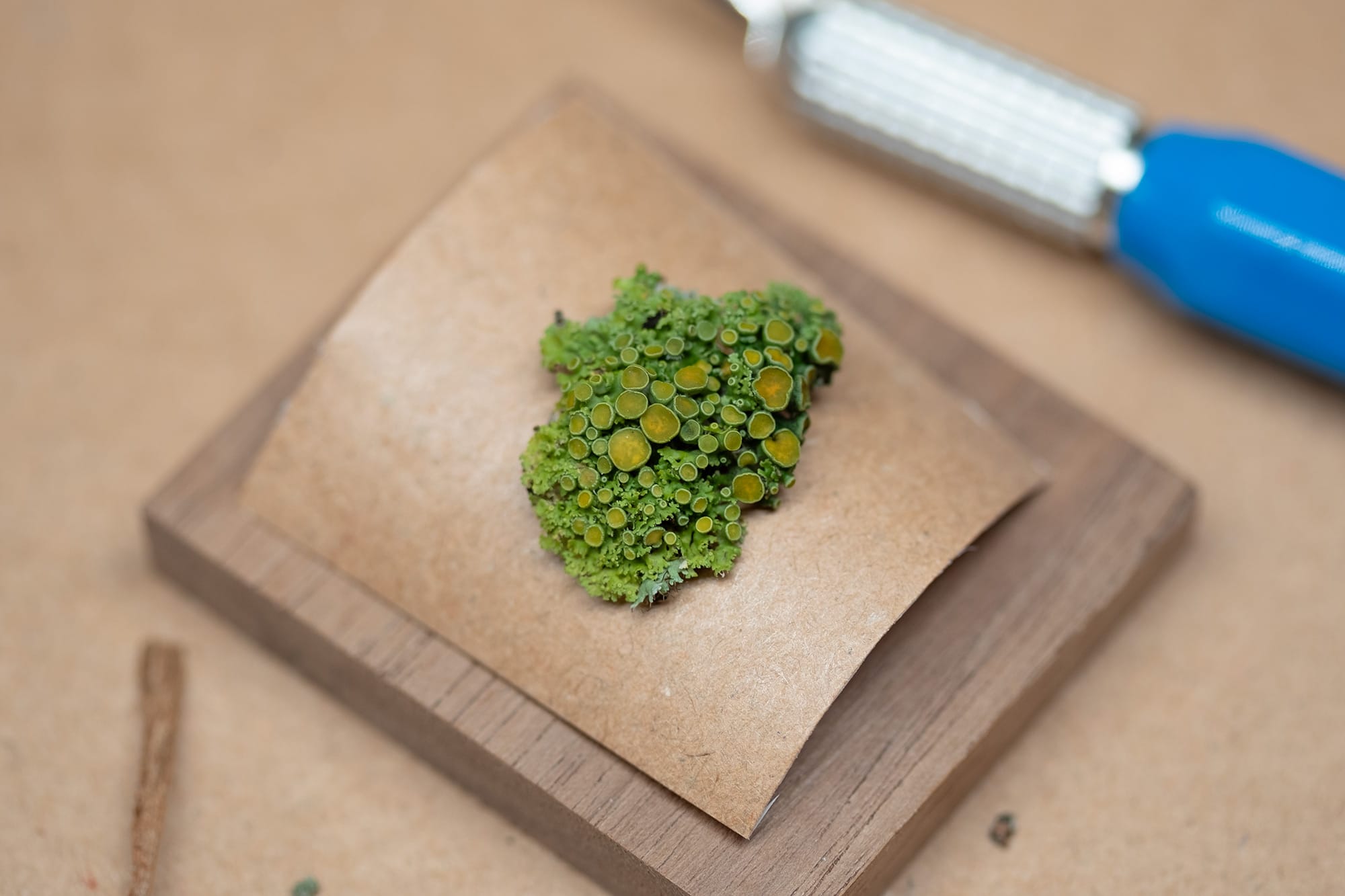
After I've separated a lichen specimen, the next step is to flatten and dry it. This is done by placing the lichen on a flattening board (in this case a piece of walnut wood).
Paper towel is placed on top of the lichen and then clamped firmly in place with masking tape.
The flattening board should be porous so that moisture can escape quickly.
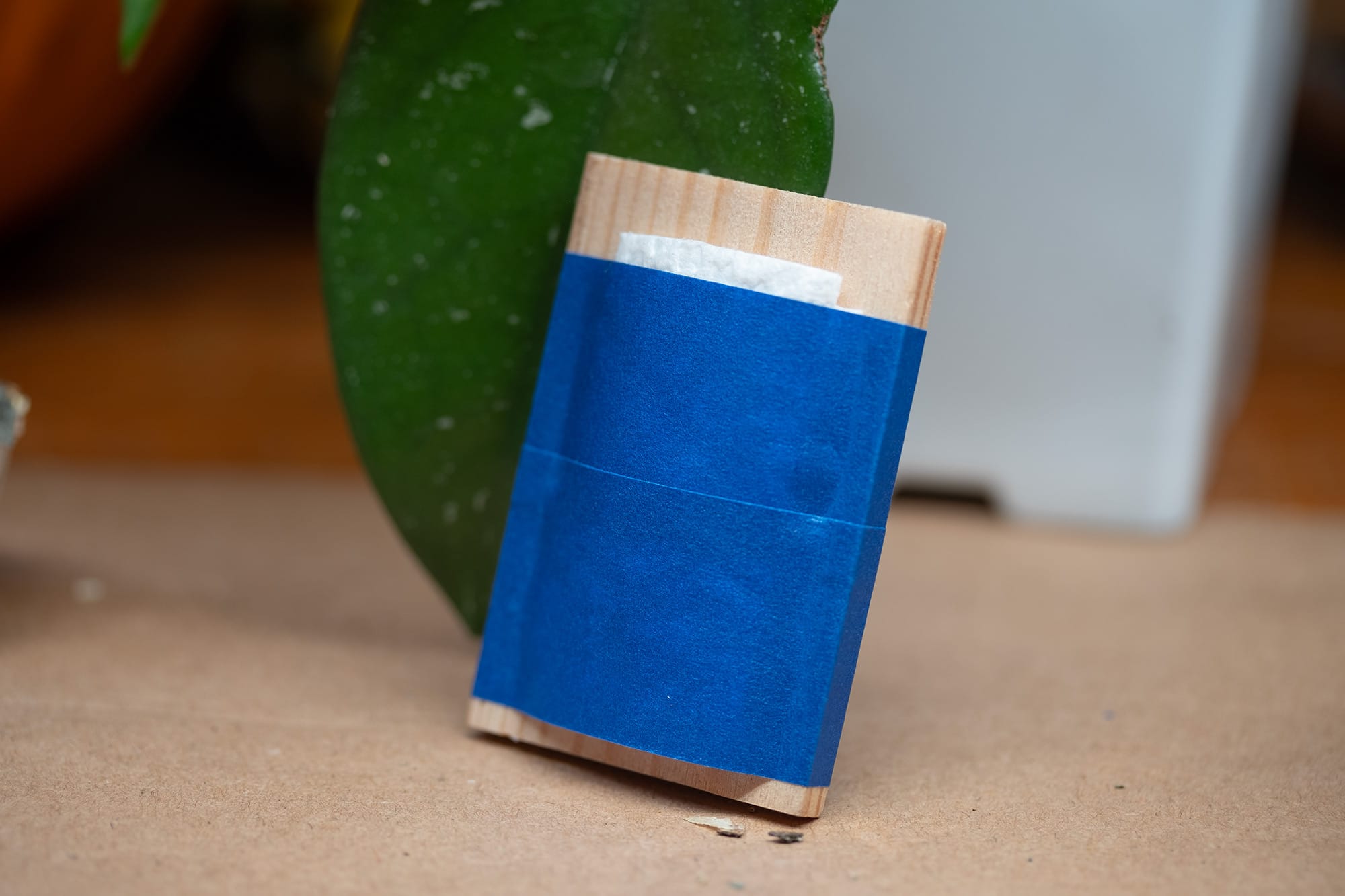
The paper towel acts as a moisture wick and padding. The lichens are easy to over flatten, and so this extra padding prevents that.
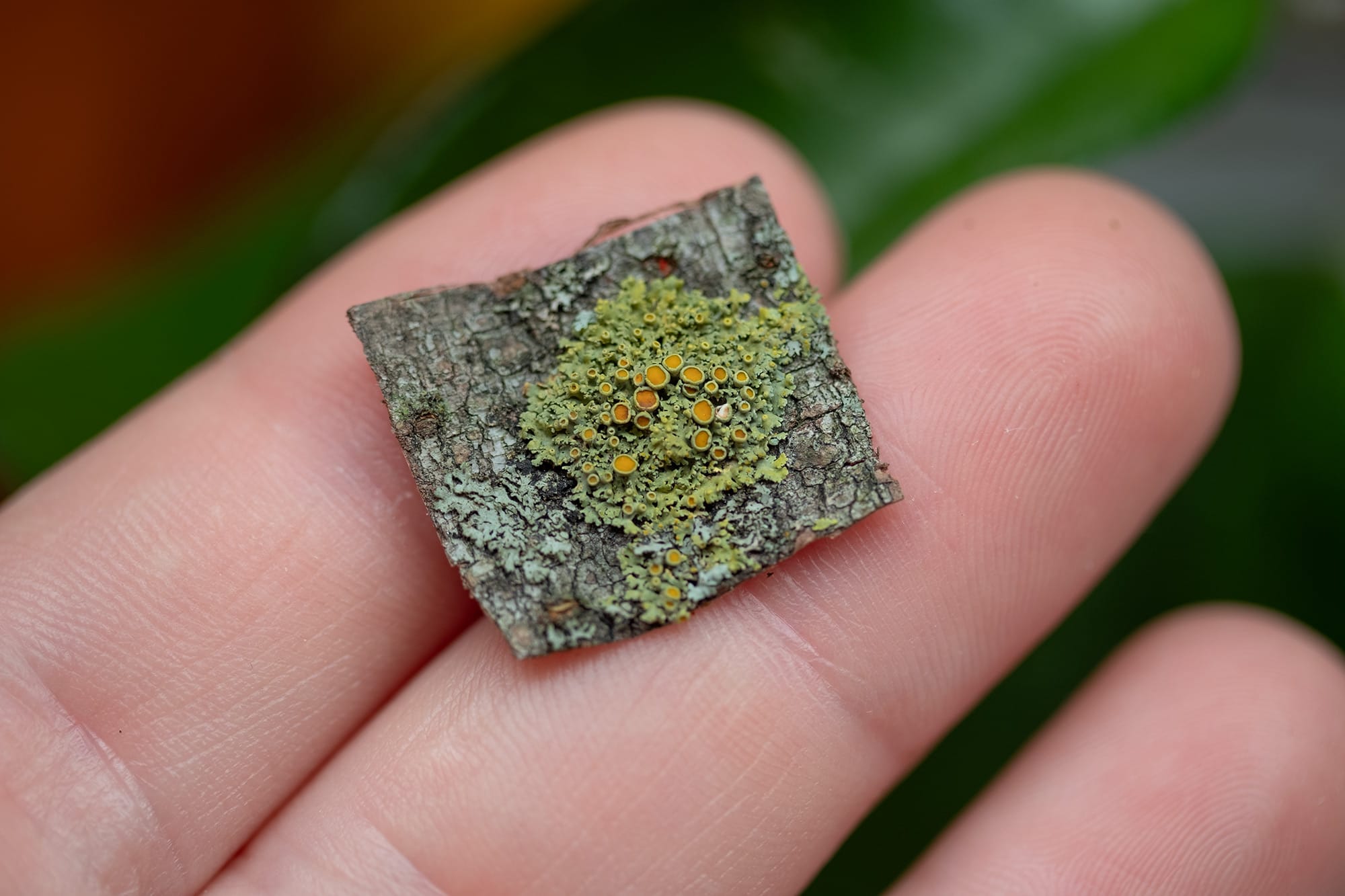
After drying for a few days, they emerge looking like this. What was once a curved slice of bark is now flat.
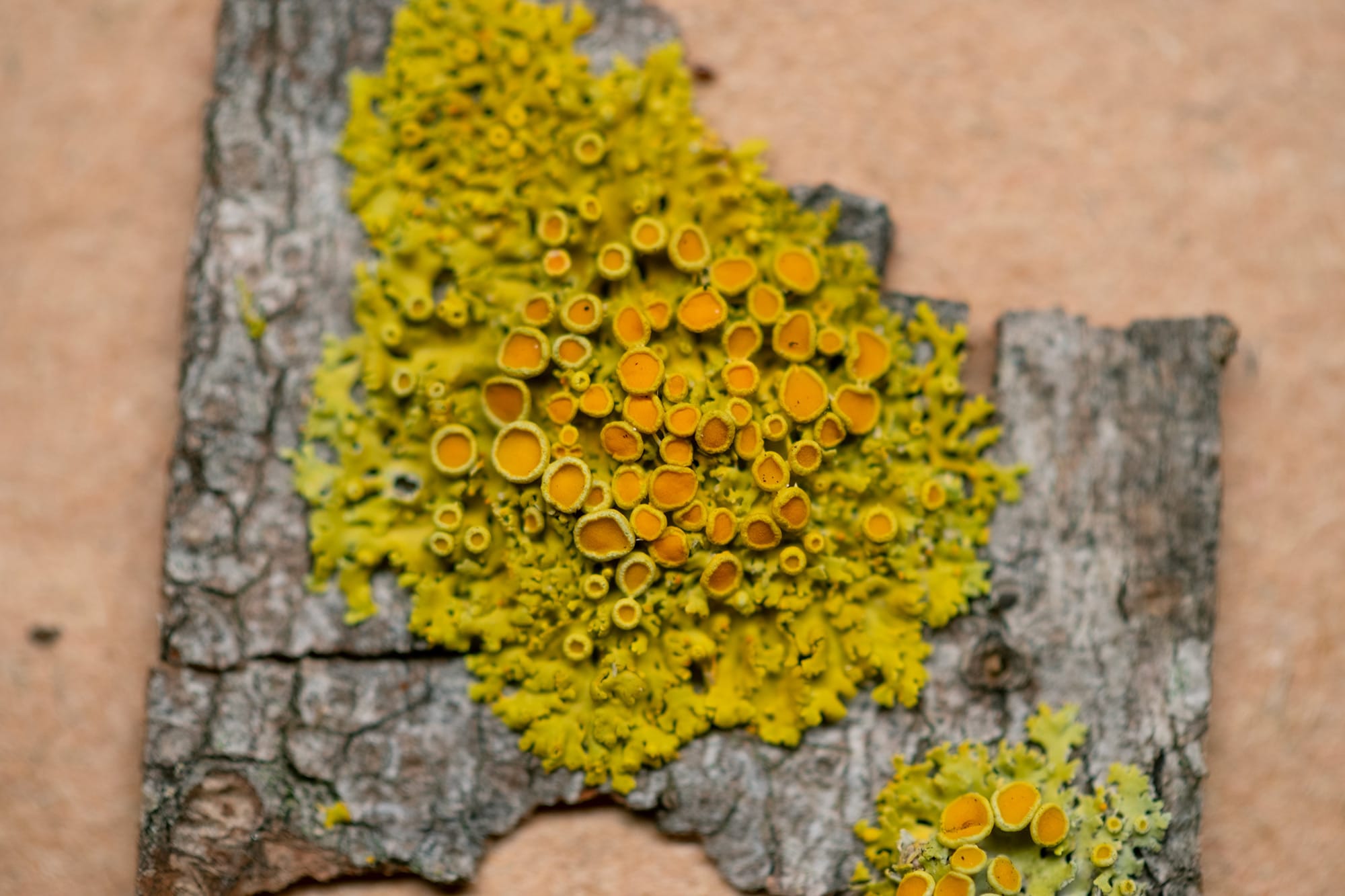
Ready for the next step.
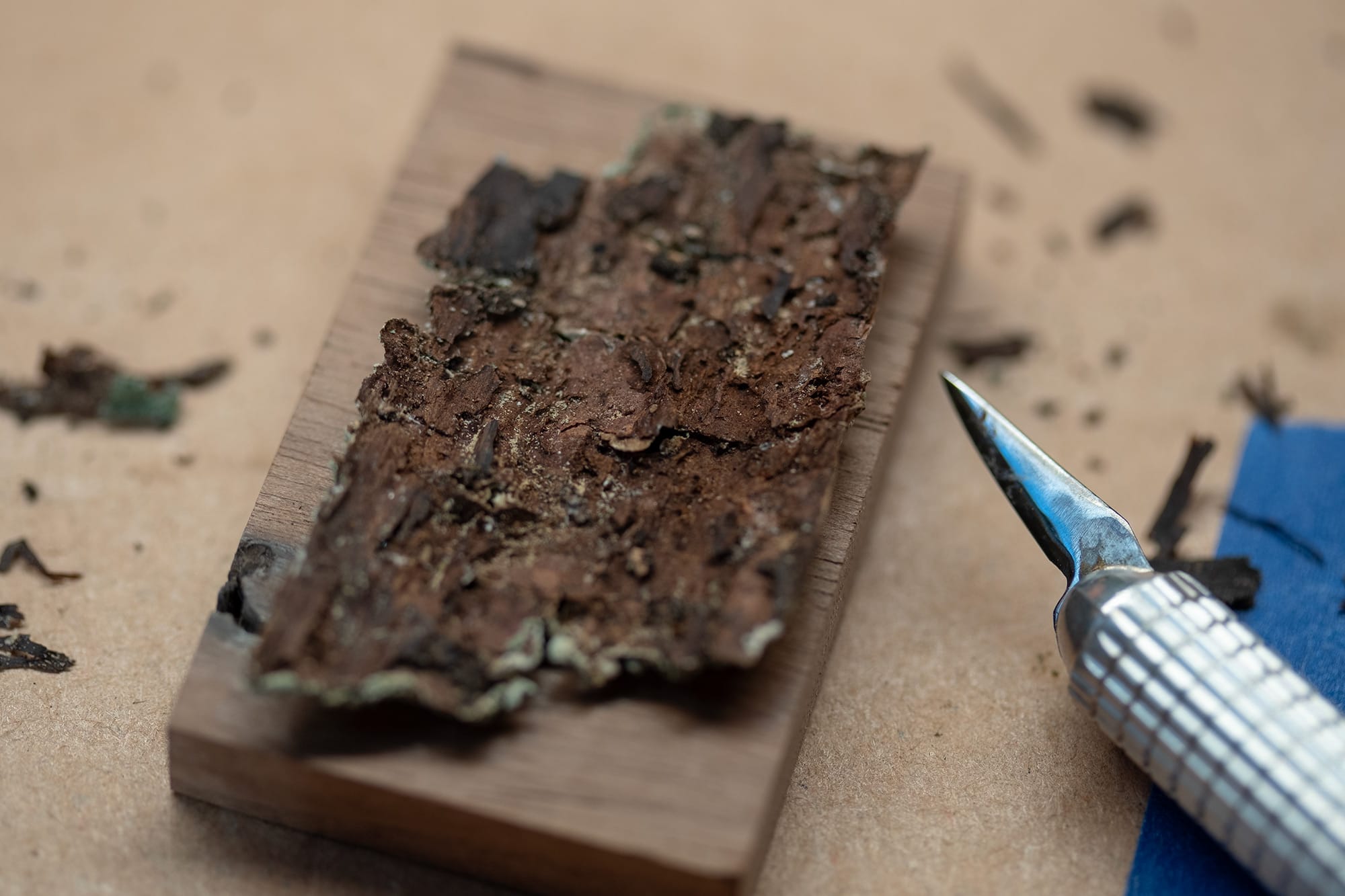
Some lichens are clean on the backside, but most require a bit of work. This lichen was growing on a dead spruce branch, and so the decayed bark and organic debris needs to be scraped off. This process reduces the overall thickness and creates a better gluing surface. I only have so much depth to work with inside of the brass button housings, so every lichen needs to be under a certain thickness.
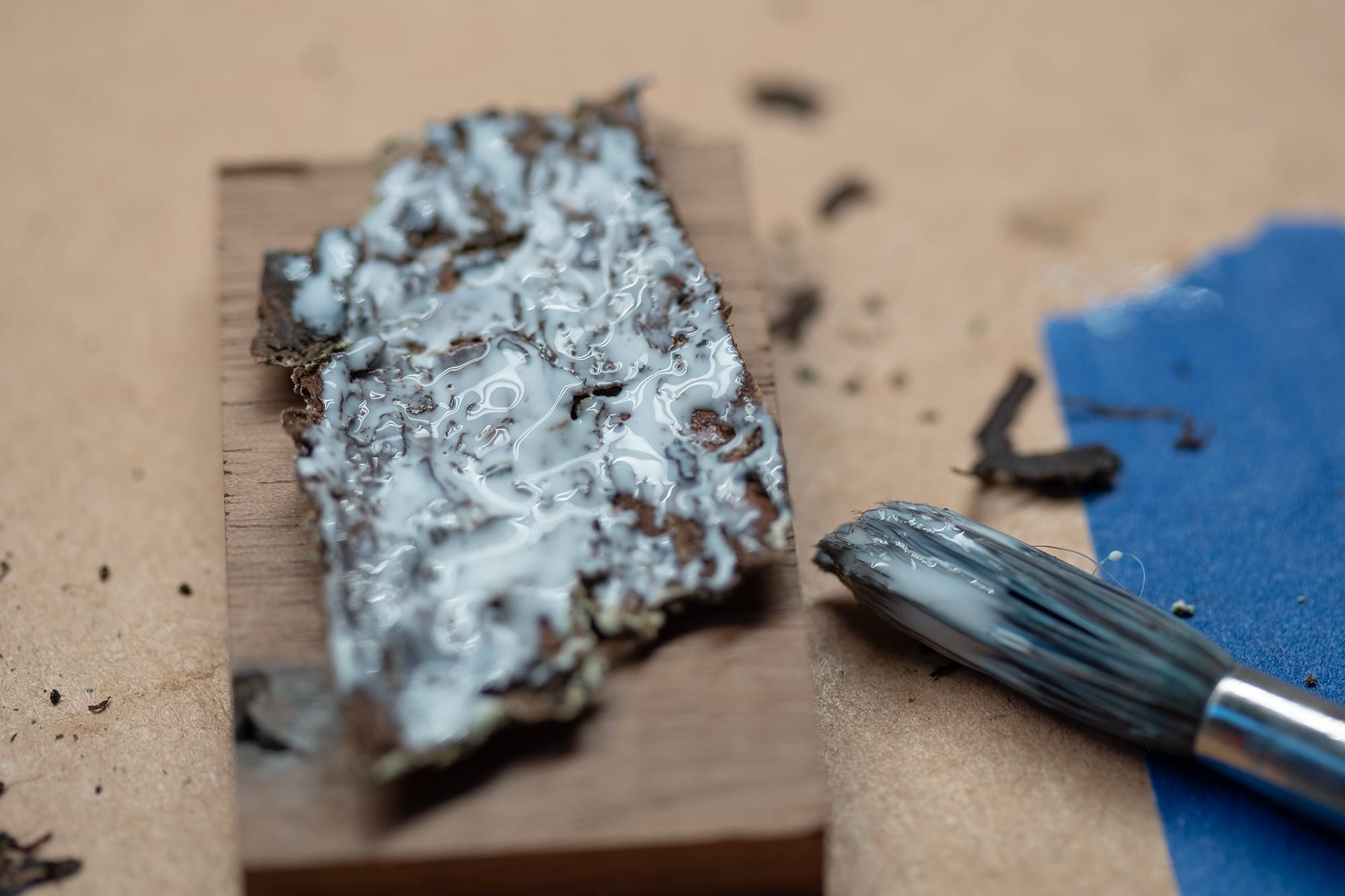
After cleaning, the backside of each lichen is brushed with PVA glue. Any archival, acid-free, matte, PVA will do.
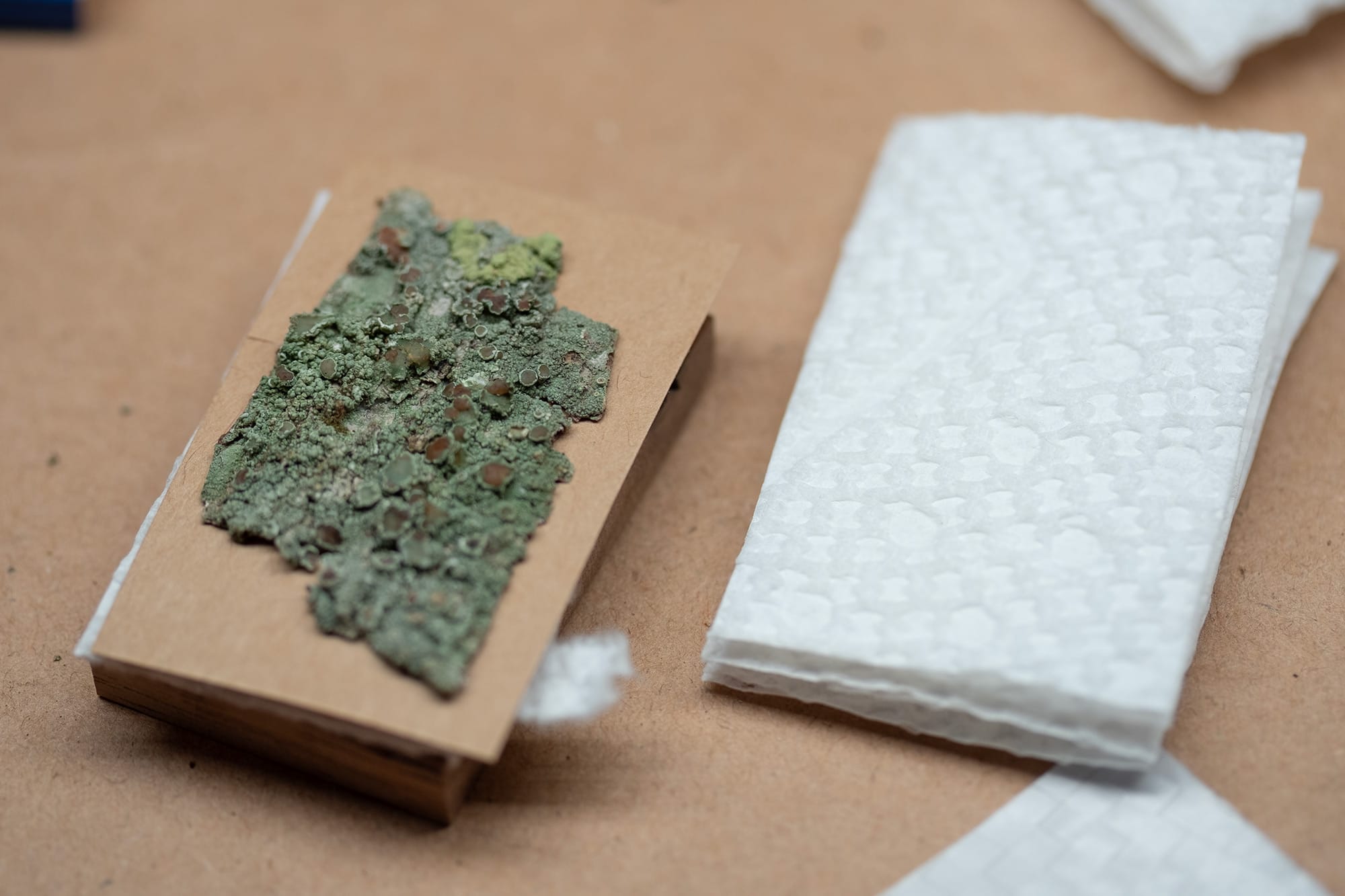
The lichens are adhered to thick kraft or washi and sandwiched again with a wood block, paper towel, and tape.
This part of the process stabilizes the lichens and makes them durable enough to be cut out into discs later on.
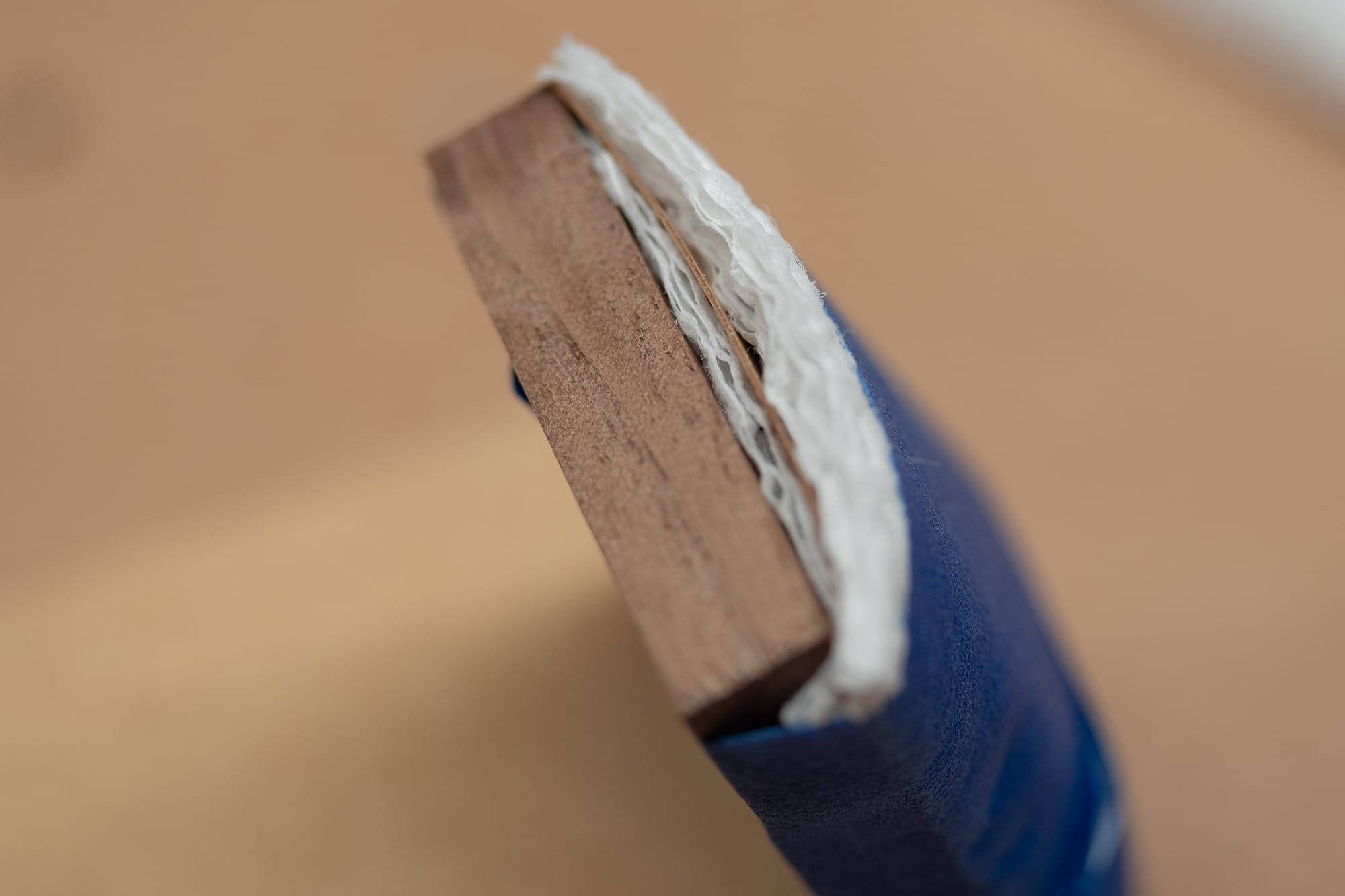
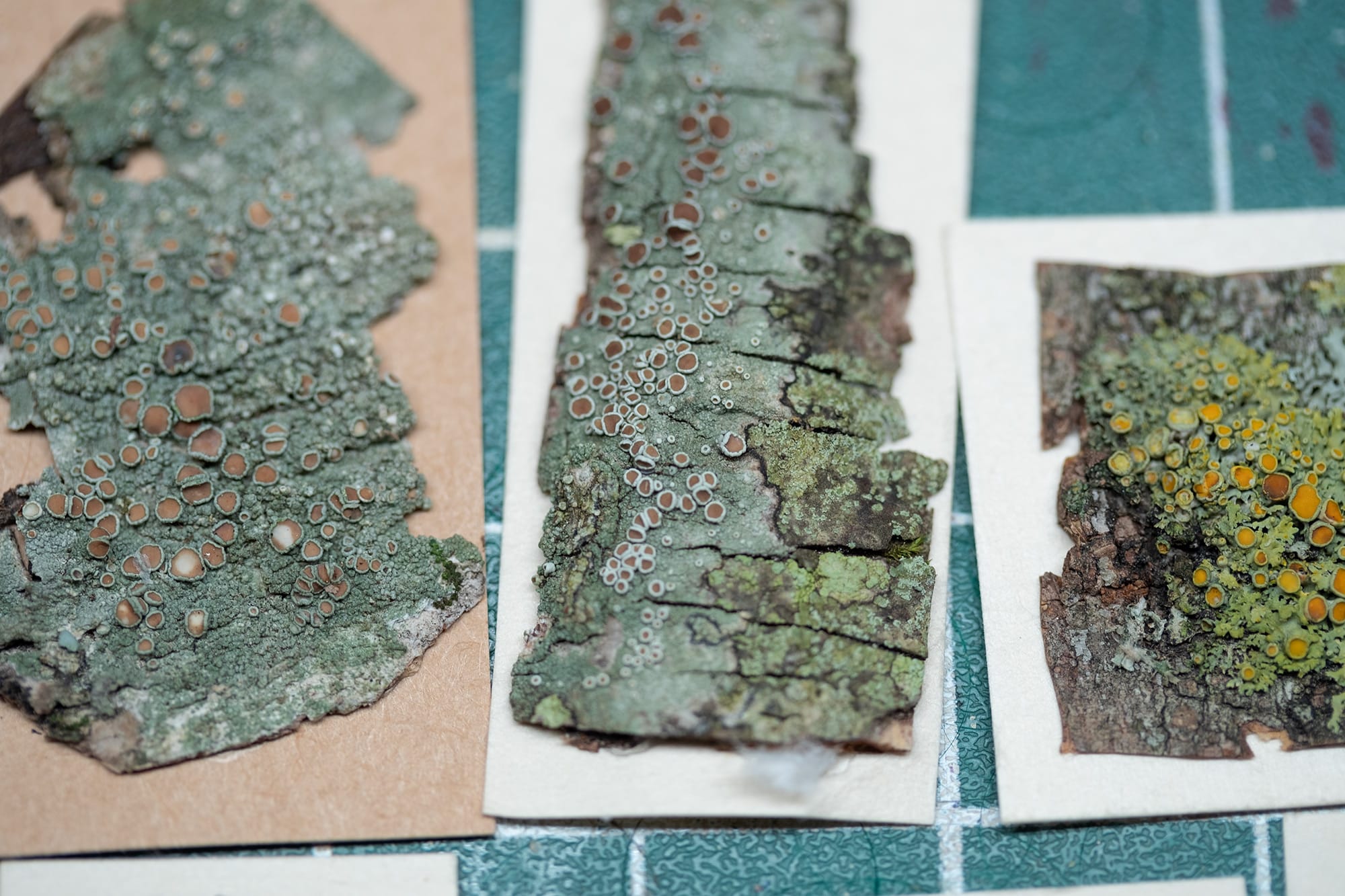
Here's how they look after another day or so of drying. At this point they are very stiff and strong.
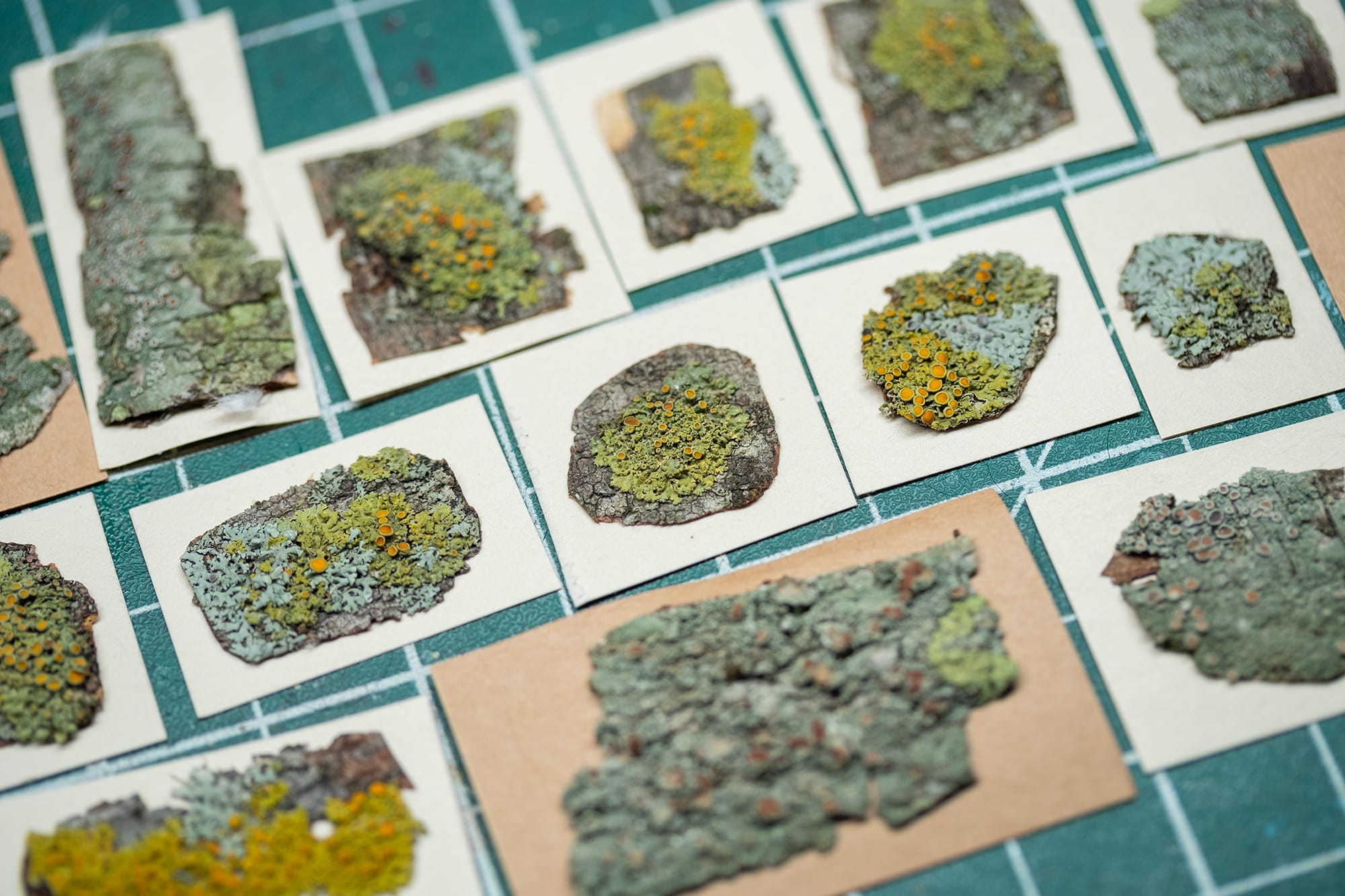
Ready to be cut out into discs.
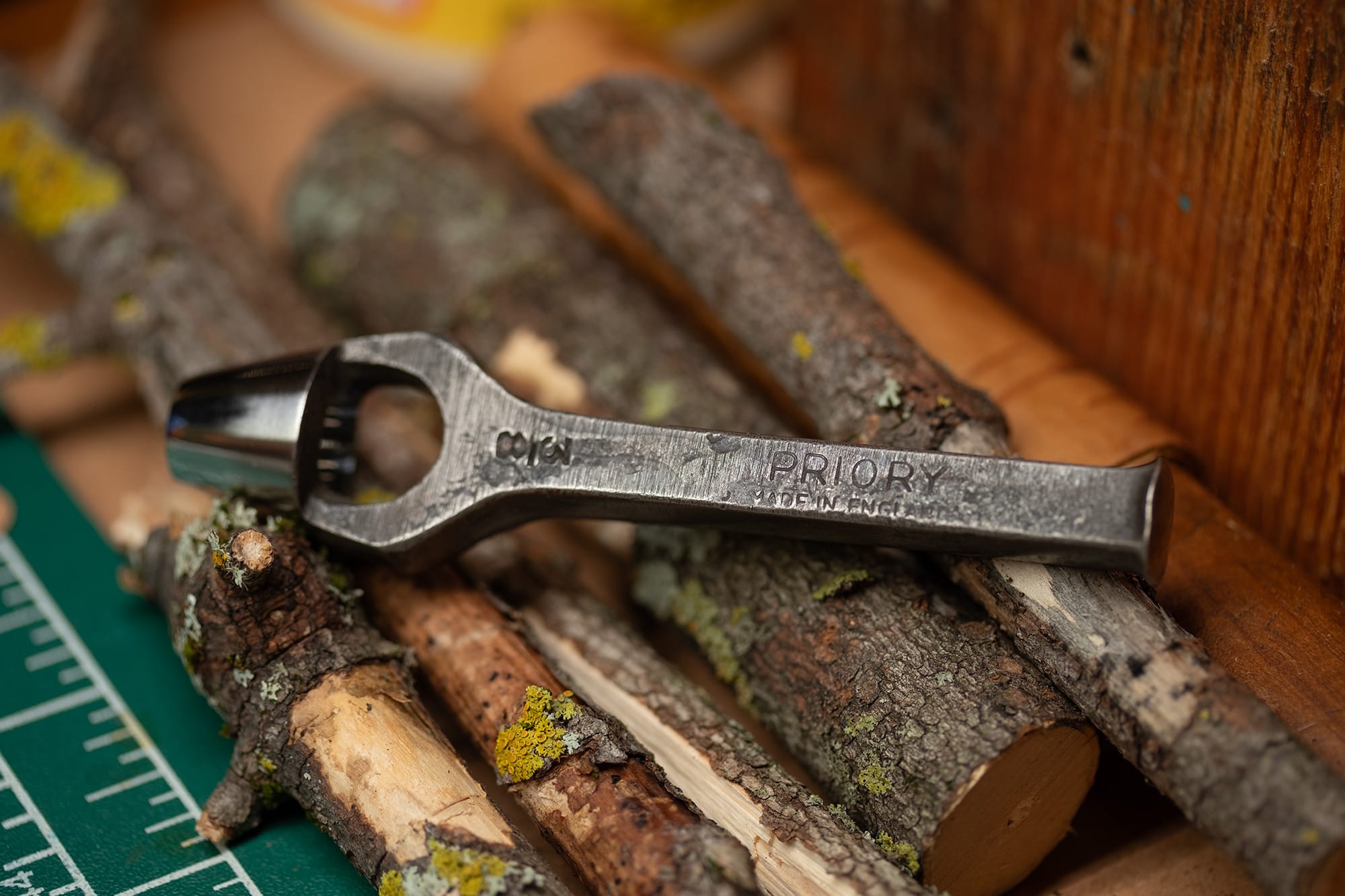
I use a hole punch that I modified to cut the correct size of disc. The edge has been honed razor sharp. If a dull punch is used it'll tend to break some of the more delicate features of the lichens rather than slice through them cleanly.
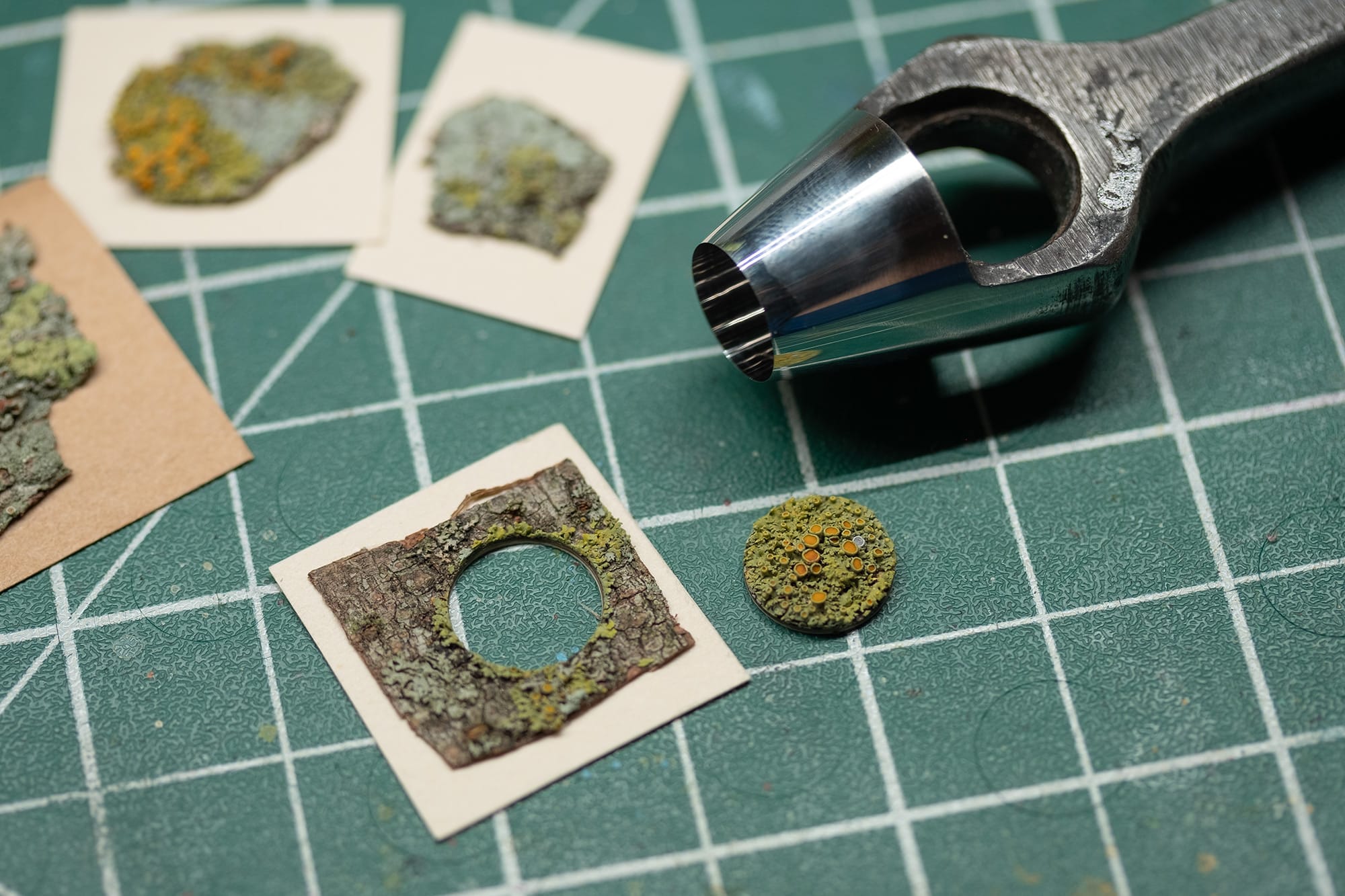
Each specimen is looked over carefully... at this point I'm in the editing phase, cropping in on the frame that'll end up being the final picture.
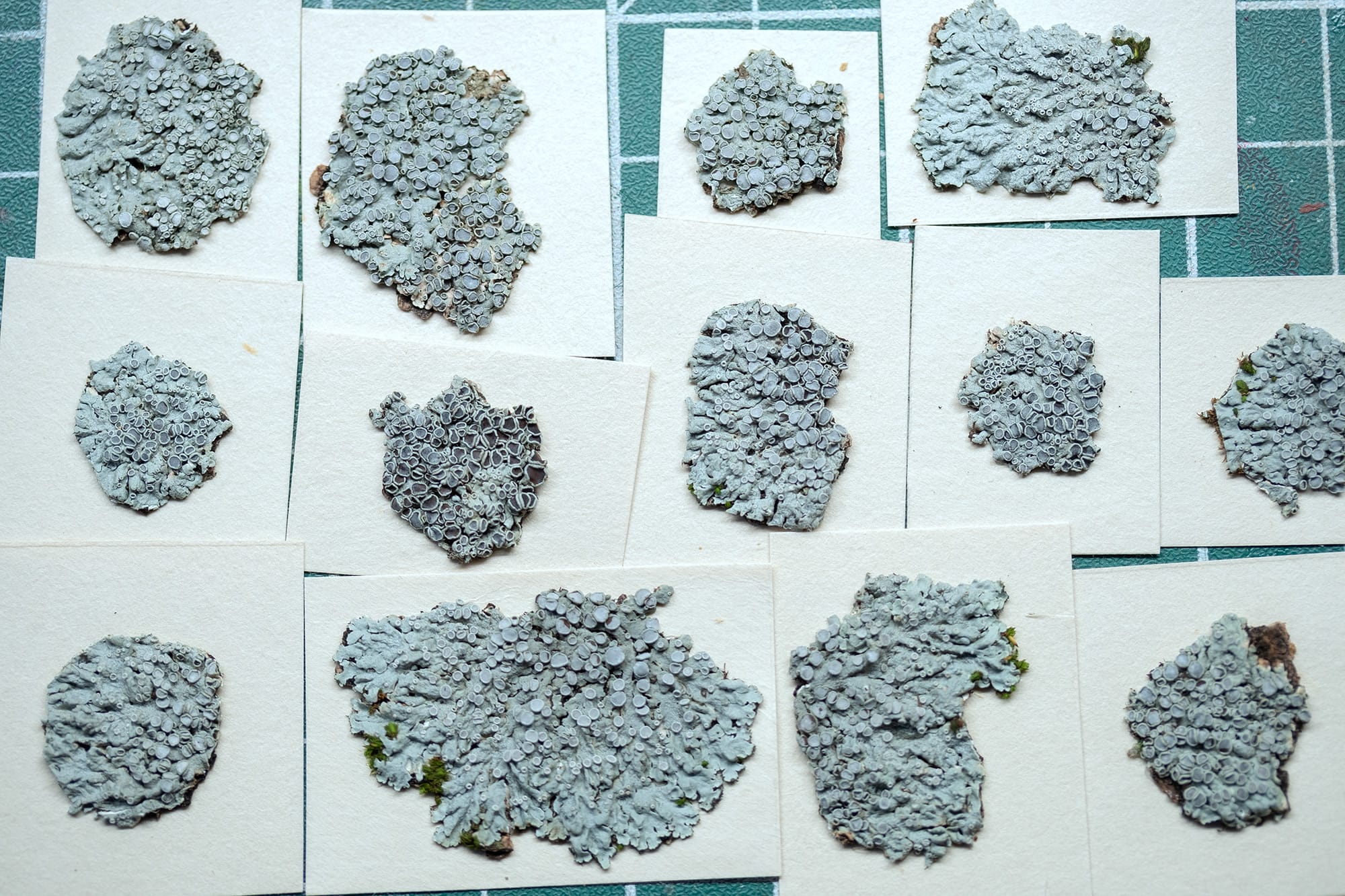
These blueish beauties are tough to find without cracks.
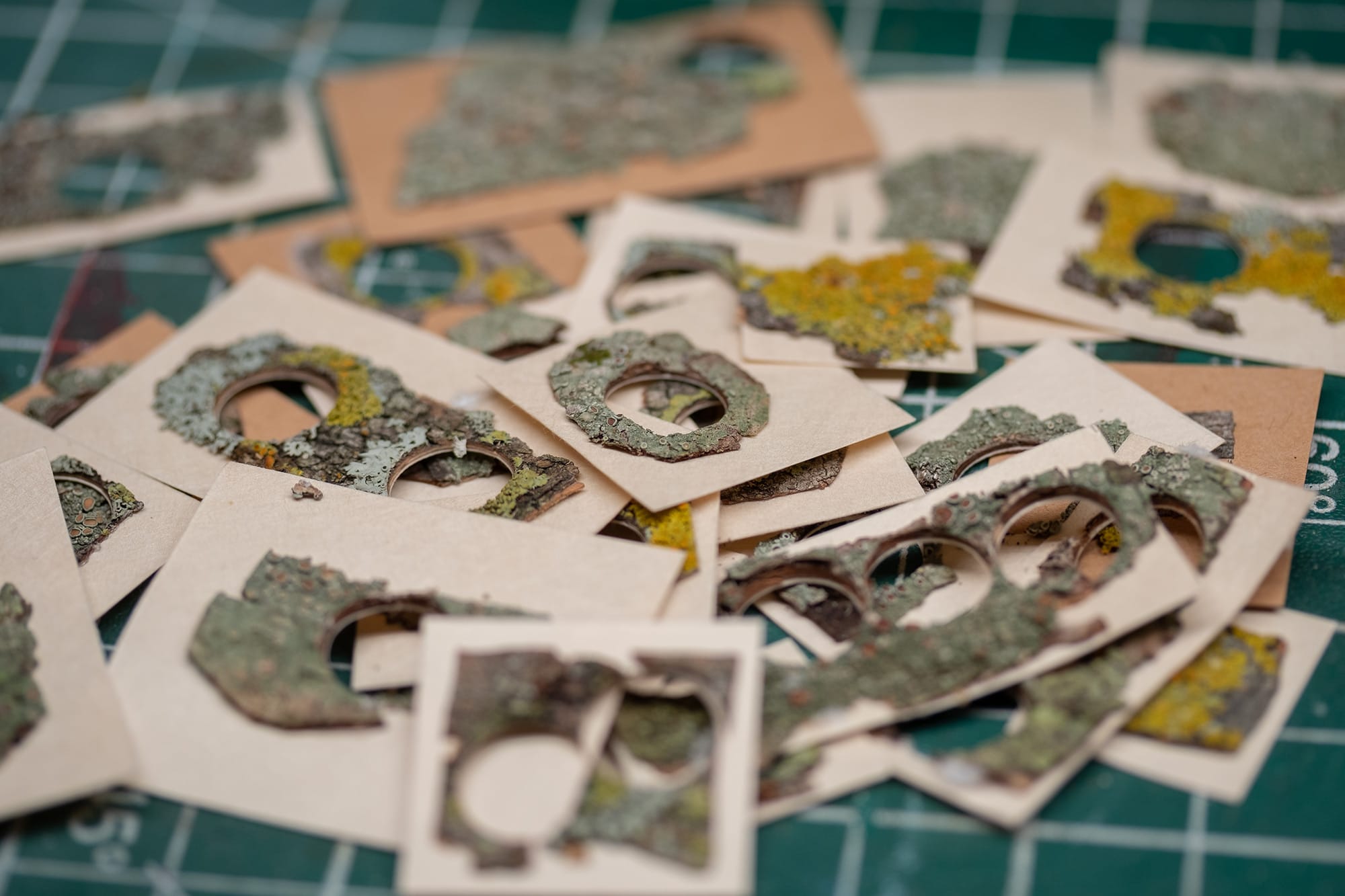
The leftovers.
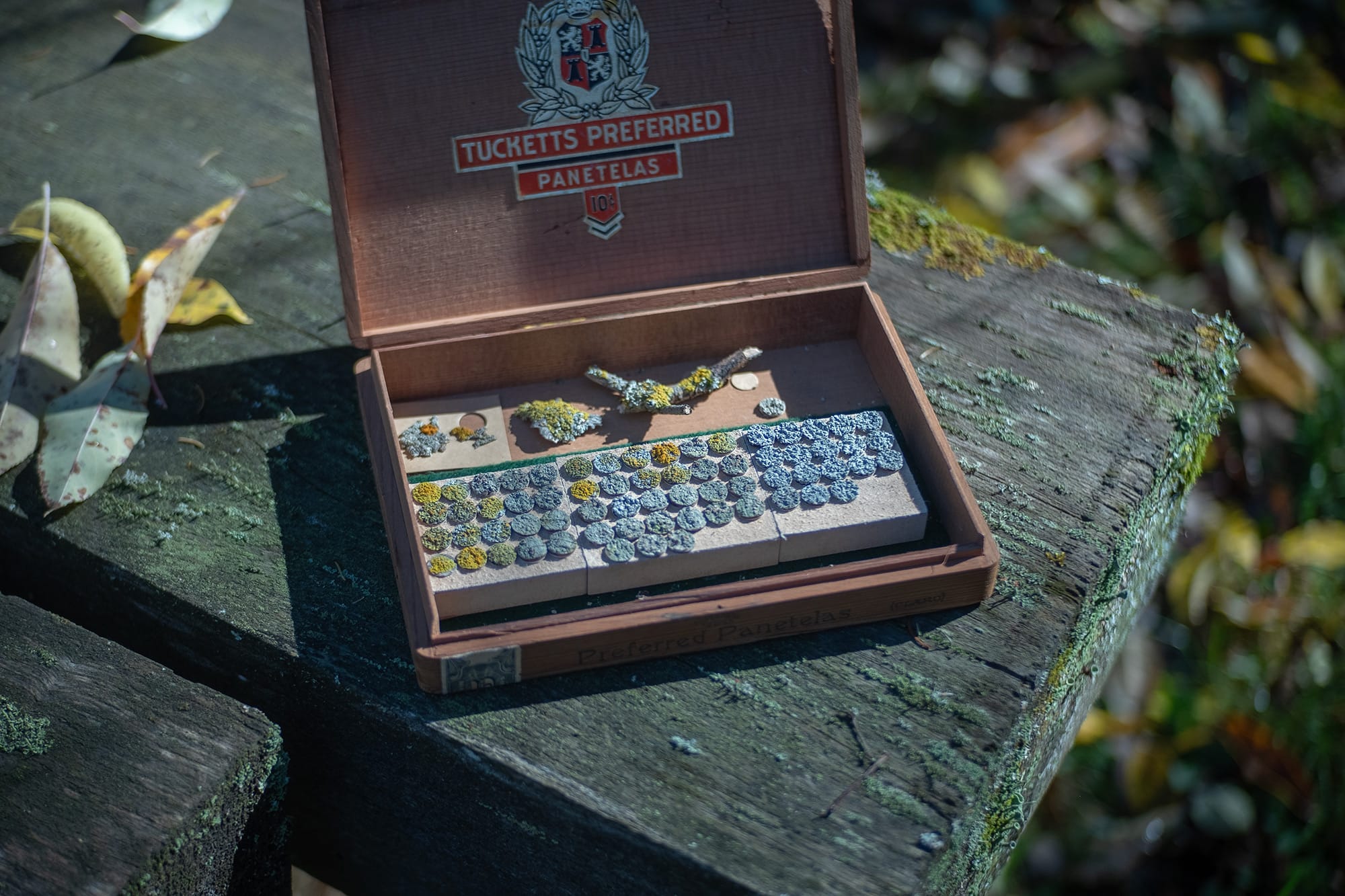
The loot, the best of the best.
It's only until they're brought back outside do they're true colours show. Like many natural pigments, only sunlight can reveal their full splendor.
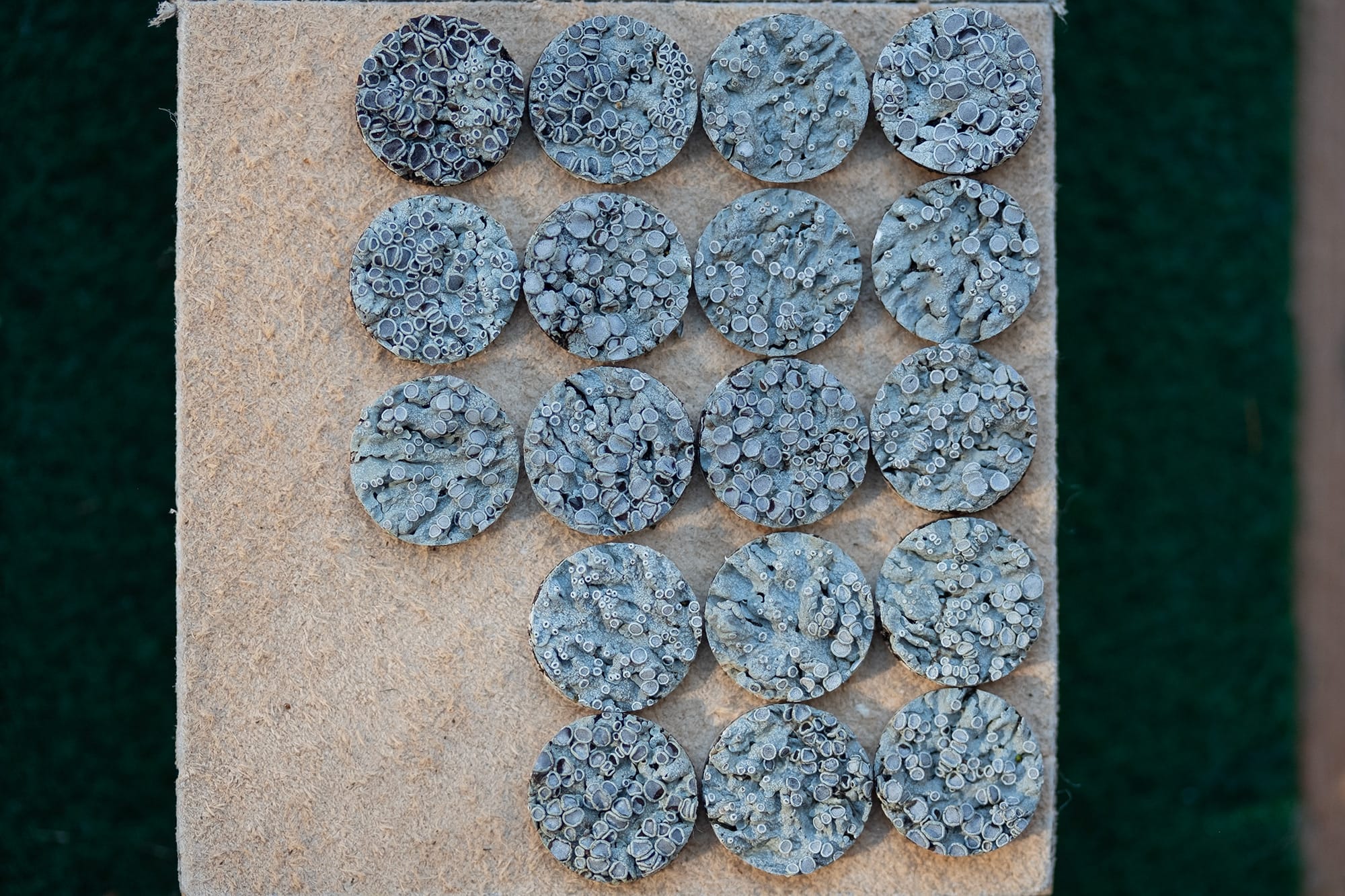
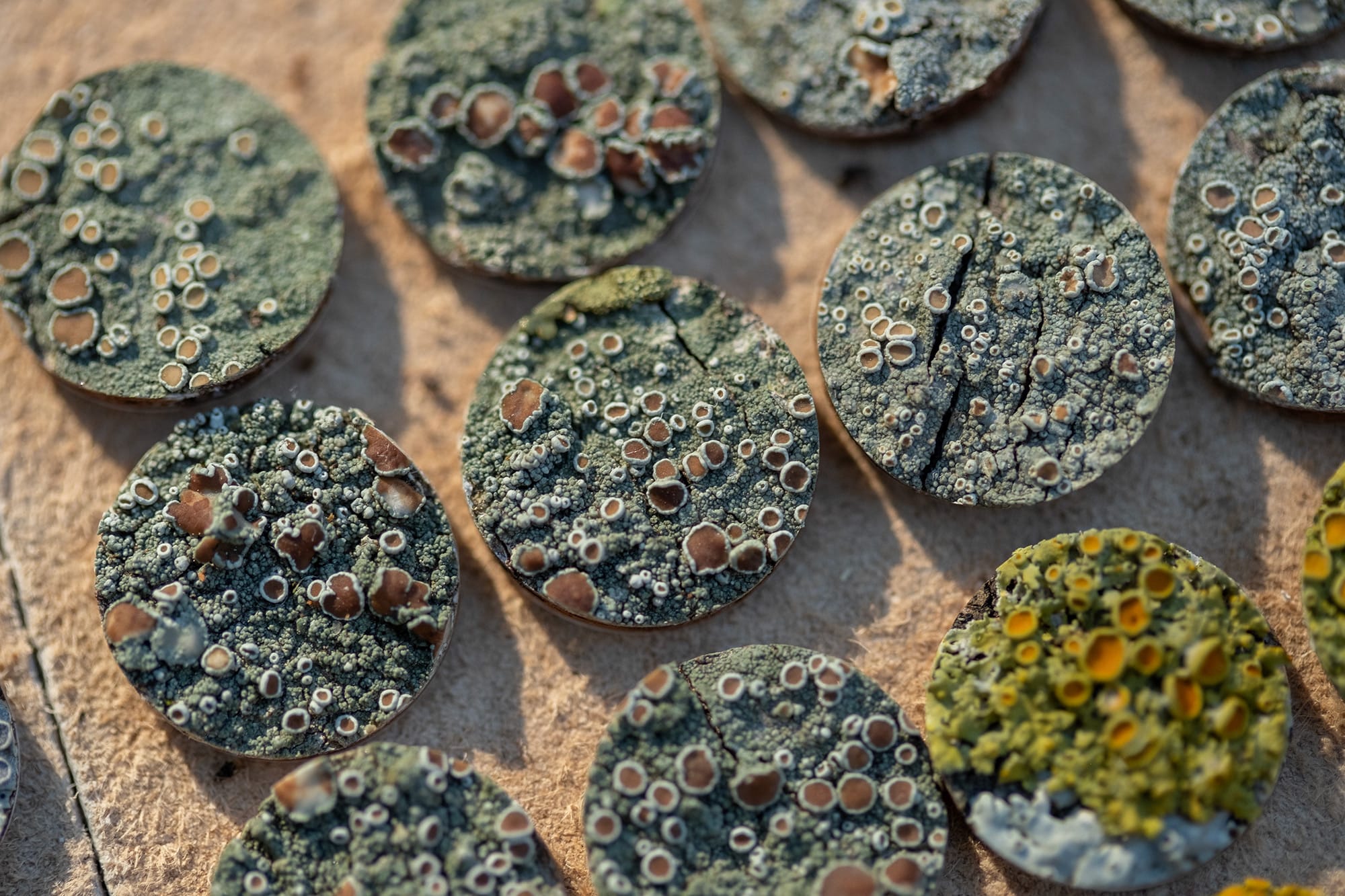
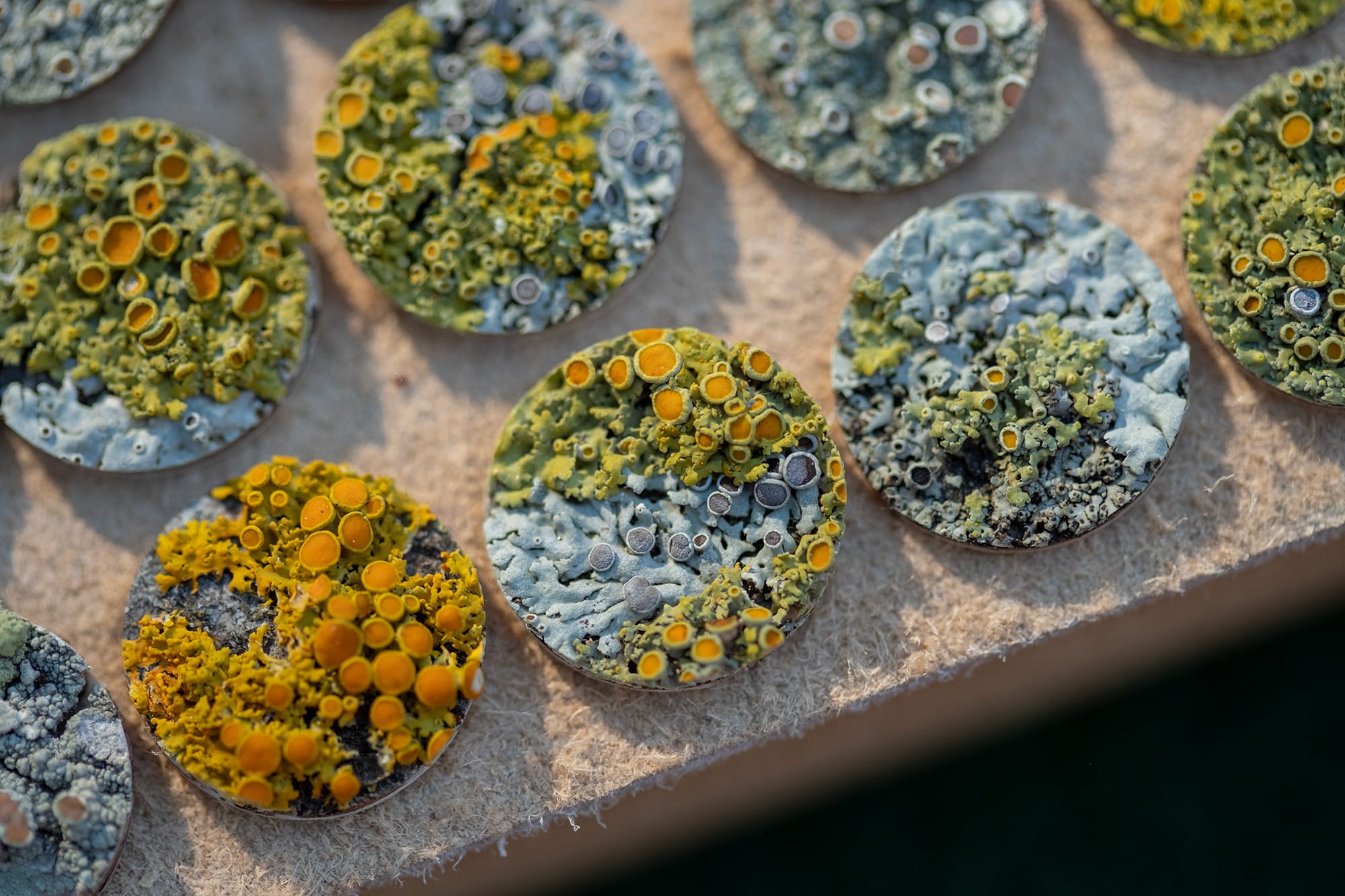
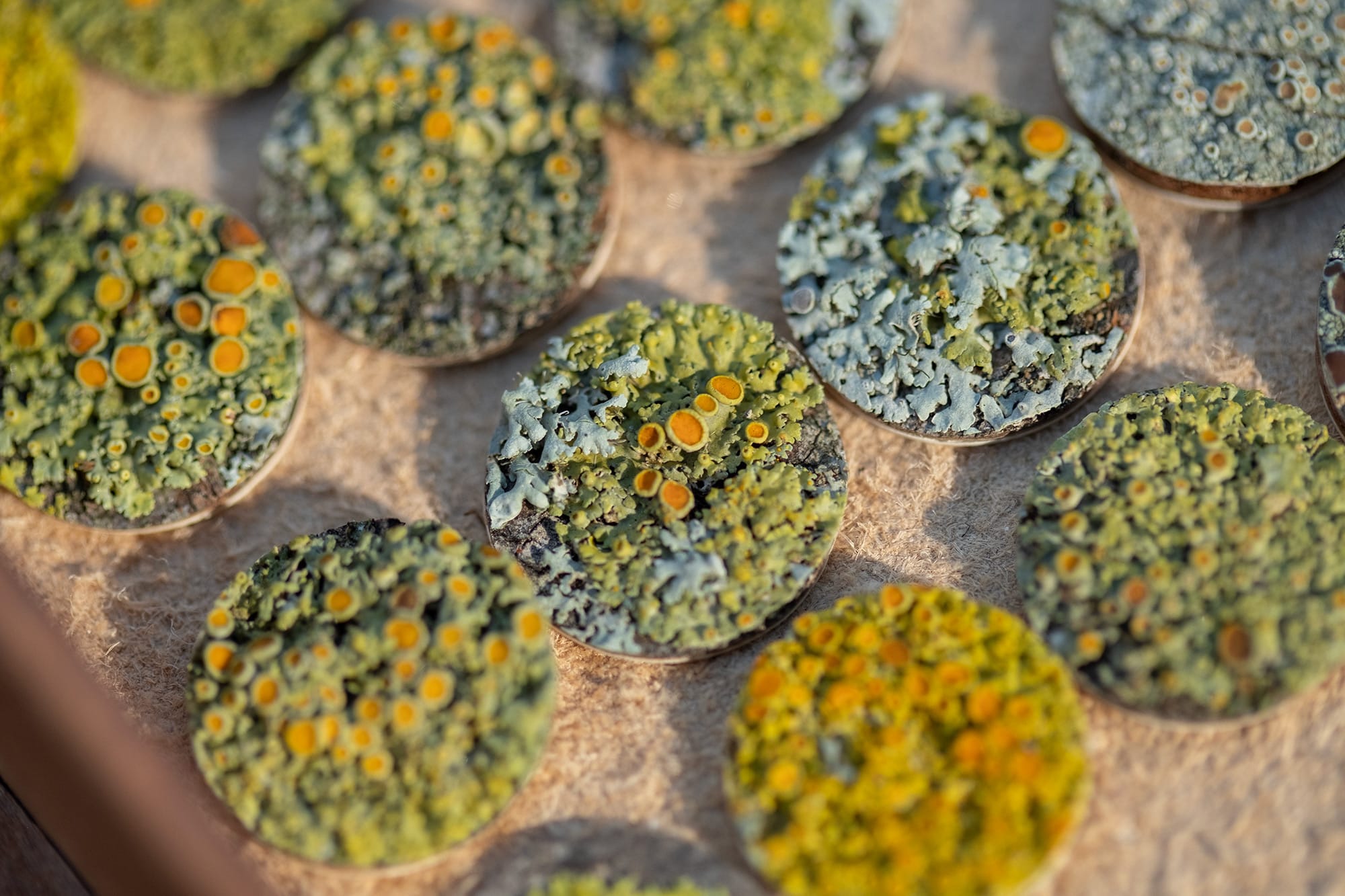
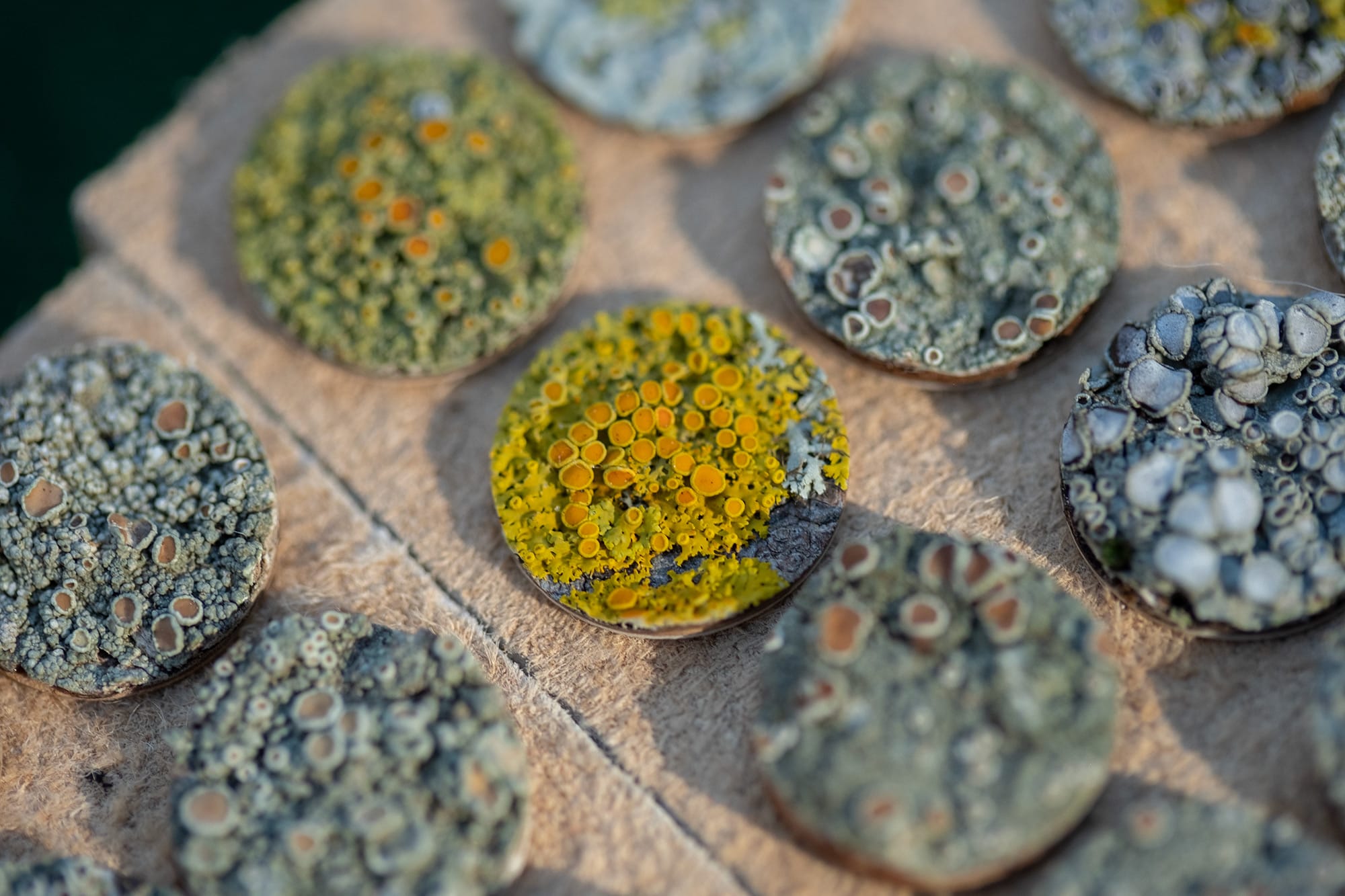
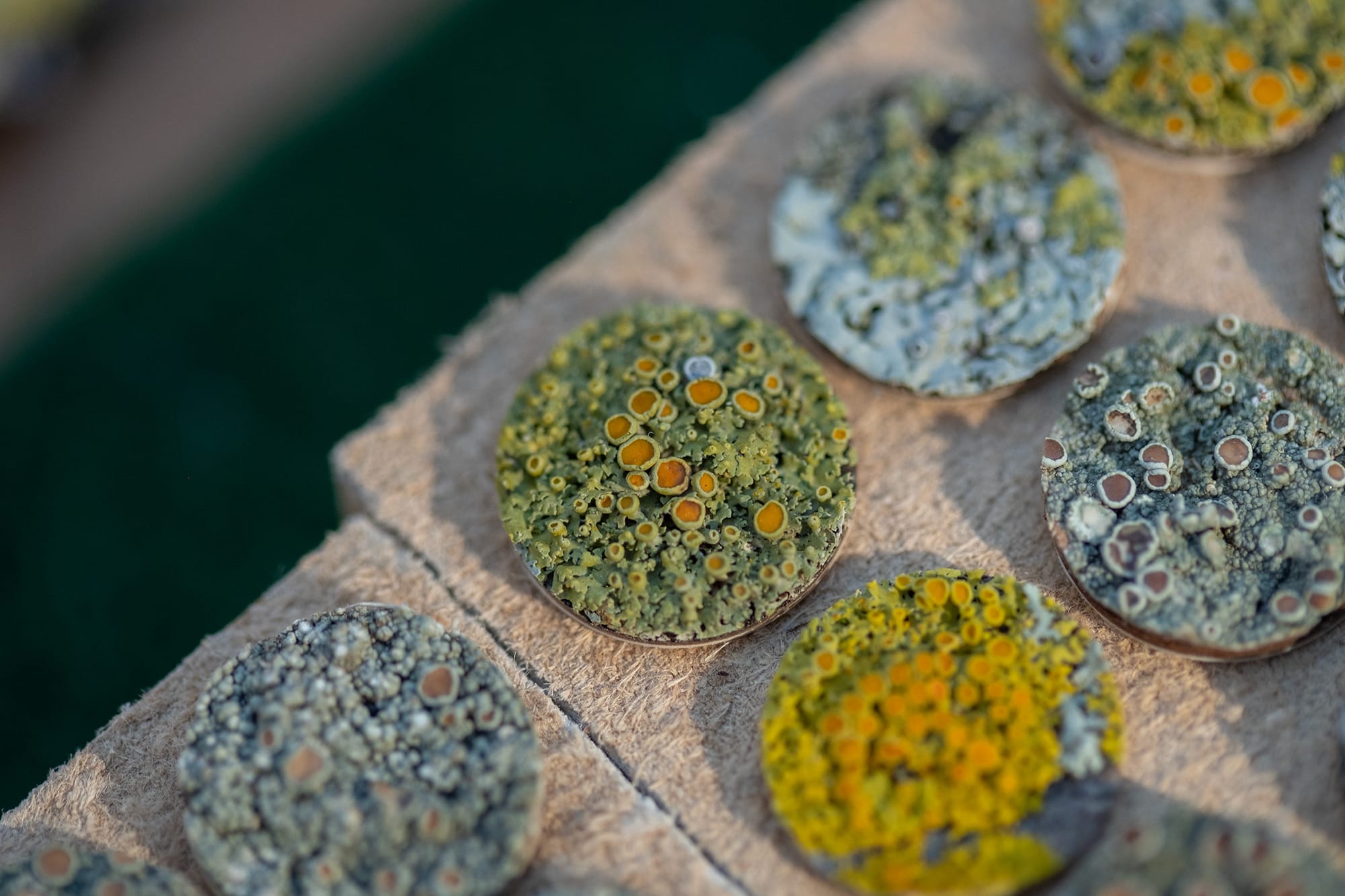
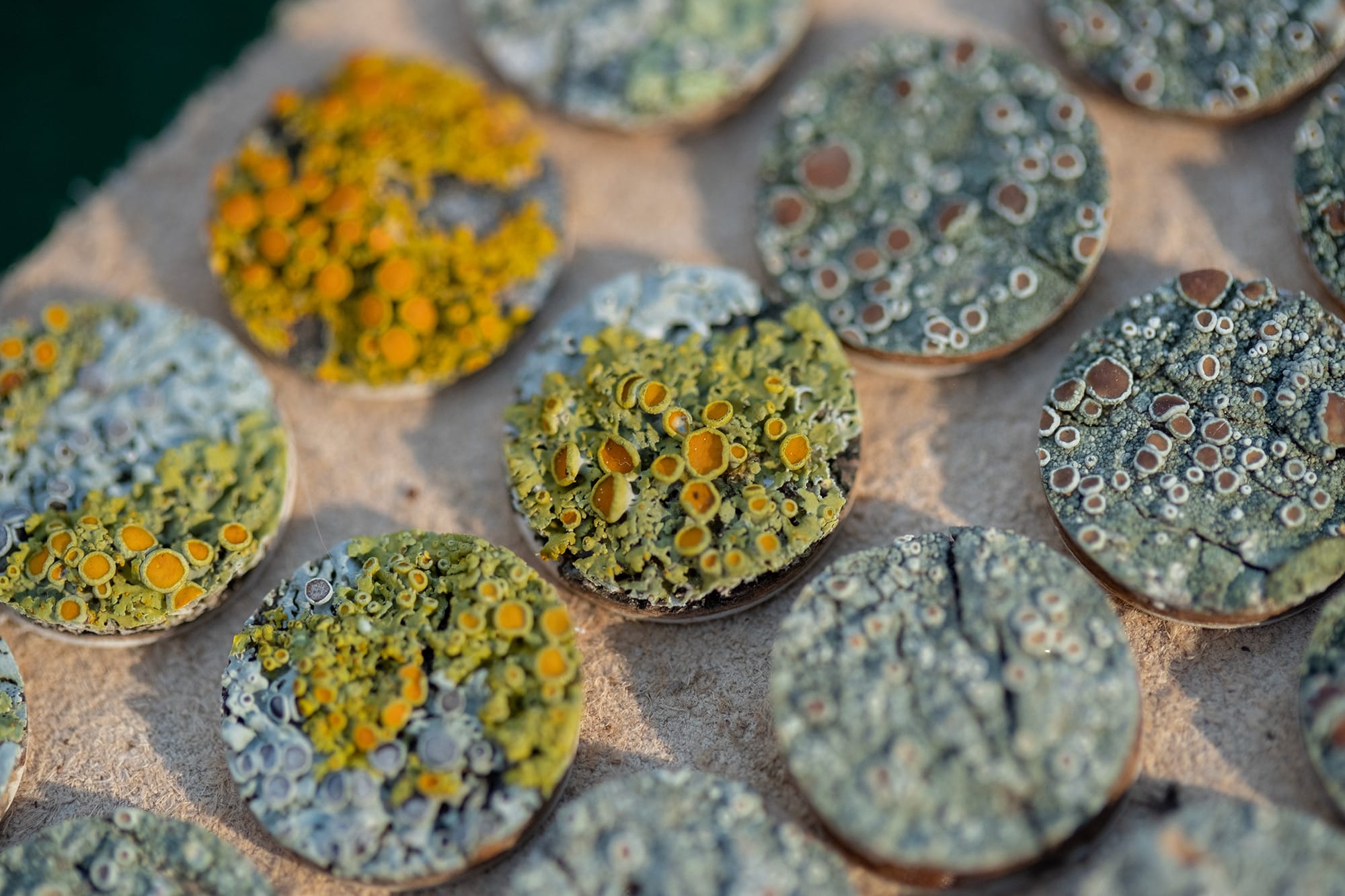
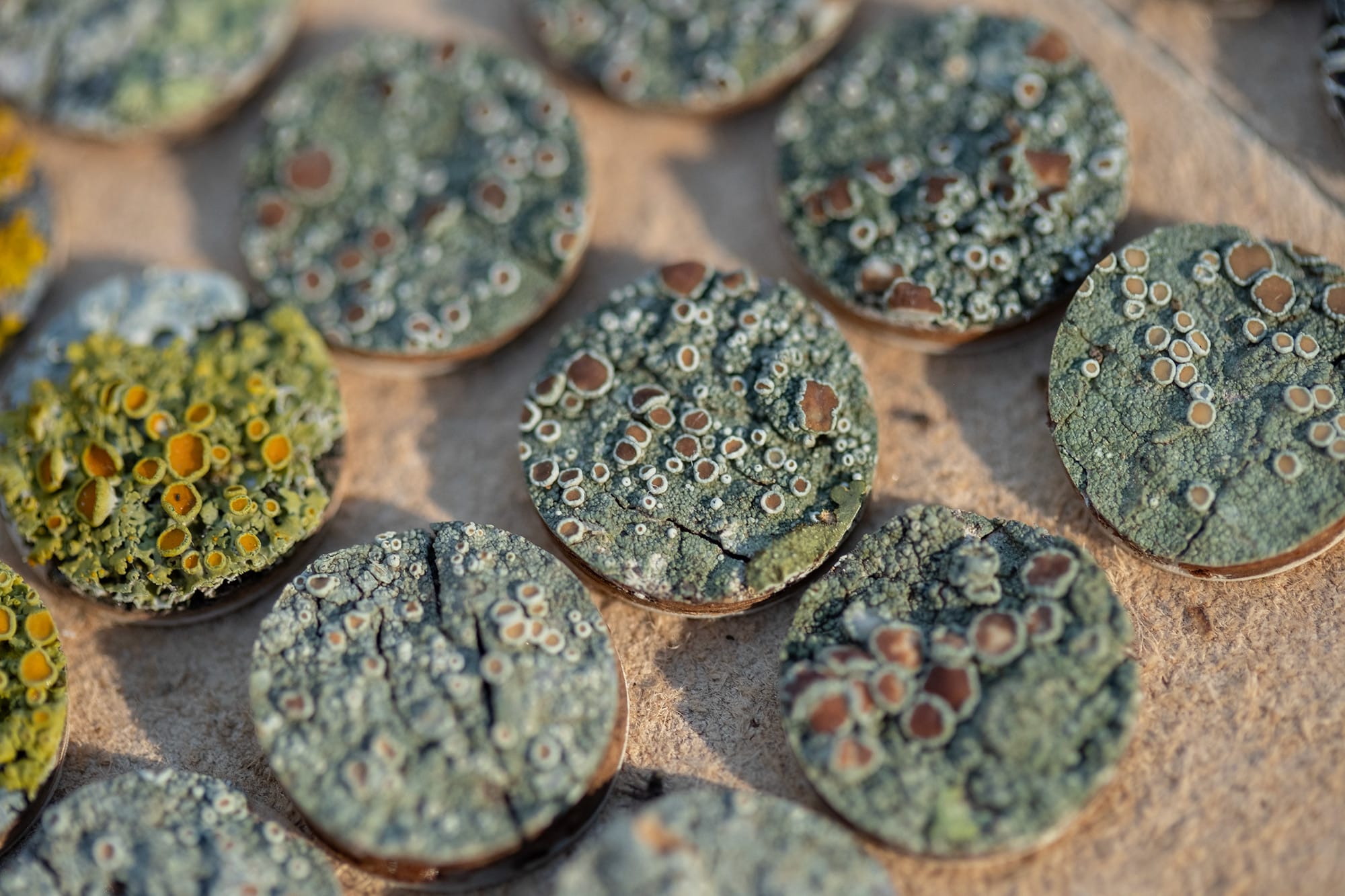
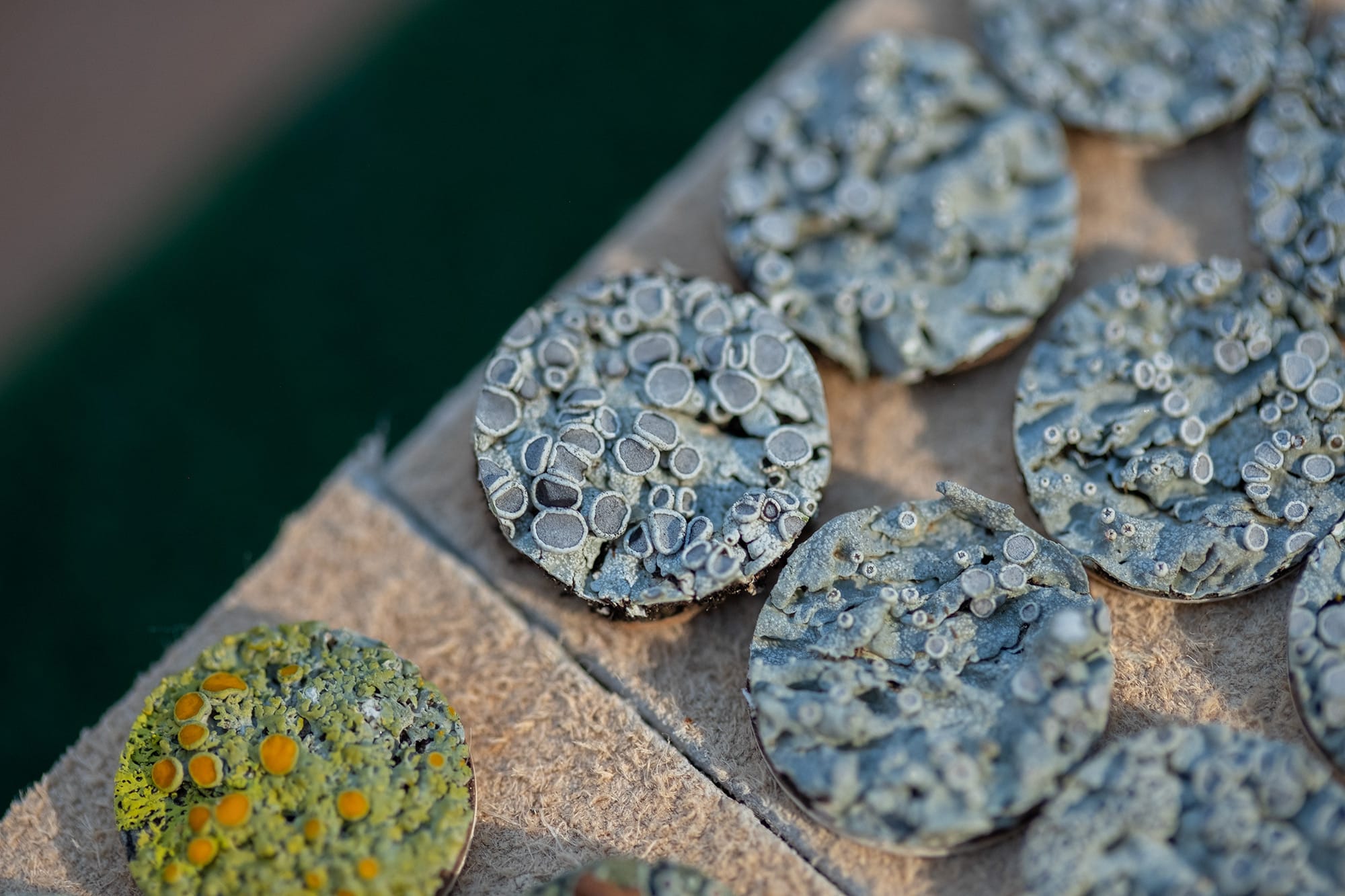
These are all the lichens I'll need for this batch. The next step for them will be to incase them in brass/acrylic. Each one will be paired with a complimentary Toad body.
It makes me very happy to see these have a second life... going out to their new caretakers where they'll be admired for years to come.